
Social Investing: What You Can Learn From Other Investors' Portfolios
Published: June 28, 2026
•Joseph Hughes
Social investing is one of the most interesting shifts in how everyday investors learn their craft. Instead of relying solely on financial news or the polished commentary of pundits, you can now see what other real people actually hold, how they size their positions, and how their portfolios behave over time. Used well, this transparency is a powerful learning tool — but only if you understand what it can and cannot teach you.
This post explores what social investing really means, the genuine lessons you can draw from other investors' portfolios, and the very real risks of doing it badly. The goal is not to hand you a formula for copying strangers, but to help you turn the collective behaviour of a community into thoughtful research inputs for your own decisions.
Key Takeaways
| Question | Short, Practical Answer |
|---|---|
| What is social investing? | Learning from the visible holdings, allocation and behaviour of other investors — not blindly mirroring their trades. |
| Is it the same as copy-trading? | No. Copy-trading automates someone else's decisions; social investing keeps you in control and uses others as research inputs. |
| What can I actually learn? | Allocation, position sizing, conviction levels, diversification habits — and, crucially, other people's mistakes. |
| What are the biggest risks? | Survivorship bias, performance chasing, herd behaviour and missing context you cannot see. |
| How should I use social signals? | As a starting point for your own due diligence, never as a command to buy or sell. |
| Do I still need to do my own research? | Yes, always. Social data narrows the search; your own analysis makes the decision. |
1. What Social Investing Actually Is
Social investing is the practice of learning from a community of investors whose holdings and behaviour are visible to you. Rather than guessing what “smart money” is doing, you can observe real portfolios: which assets people own, how much of their capital sits in each position, how they react to volatility, and how their allocation evolves through different market conditions.
At its heart, social investing is about transparency and context. A traditional stock tip is a single data point stripped of everything that matters — you hear “buy this” but you have no idea whether it represents 2% or 40% of the recommender's portfolio, whether they are hedged, or how long they intend to hold. A visible portfolio restores that missing context. You see the position in relation to everything else the investor owns.
This is fundamentally different from the noise that dominates most financial media. Opinions are cheap and hot takes are everywhere, but a real portfolio is a record of decisions someone has actually committed their own money to.
Learning from behaviour, not just outcomes
The most valuable part of social investing is not the “what” but the “how”. Watching how a disciplined investor rebalances, trims winners, or refuses to chase a hyped stock teaches you far more than a single ticker ever could. Behaviour is repeatable; a lucky trade is not.
2. What Social Investing Is Not: The Copy-Trading Distinction
It is essential to separate social investing from blind copy-trading, because the two are often confused and carry very different risks.
- Copy-trading typically means automatically mirroring another person's trades, often in real time, with your own capital. Your outcomes are tied to their decisions, and you usually have little insight into their reasoning, risk tolerance or personal circumstances.
- Social investing keeps you in the driver's seat. You observe, question, and learn from other investors, then make your own independent choices. Their portfolio is a source of ideas and lessons, not a set of instructions.
The problem with blind copying is that a portfolio is deeply personal. Someone else's allocation reflects their time horizon, their tax situation, their income, and their appetite for risk. A 30-year-old with decades of earning ahead of them can hold a concentrated, volatile portfolio that would be reckless for someone approaching retirement. Copying the holdings without copying the context is how people get hurt.
Seeing what someone owns tells you what they decided. It does not tell you why they decided it, when they will change their mind, or whether their situation looks anything like yours.
3. Real Holdings vs. Opinions and Hot Takes
One of the strongest arguments for social investing is that revealed preferences beat stated opinions. What people say and what people do frequently diverge. A commentator might talk endlessly about an asset class while owning almost none of it, or downplay a position they are quietly building.
Visible holdings cut through this. When you can see the actual composition of a portfolio, you gain several advantages:
- Skin in the game. A real position means the investor bears the consequences of being wrong. That tends to sharpen thinking in a way that costless commentary does not.
- Proportion and priority. You see not just what someone owns but how much conviction it represents relative to the rest of their portfolio.
- Consistency over time. A portfolio you can track reveals whether someone actually holds through turbulence or quietly bails at the first sign of trouble.
None of this makes another person's portfolio a recommendation. But it does make it a far richer and more honest signal than a headline or a confident thread on social media.
4. What You Can Genuinely Learn From Other Portfolios
When you study real portfolios thoughtfully, several categories of lessons emerge. These are the things worth paying attention to.
Asset allocation
How is capital split across stocks, ETFs, bonds, crypto and cash? Seeing a range of real allocations helps you calibrate your own. You might notice that experienced investors often anchor a large share of their portfolio in broad, low-cost index funds and treat individual stocks as satellite positions — a pattern that is hard to appreciate from theory alone.
Position sizing
Perhaps the most underrated lesson. Beginners frequently obsess over which stock to buy and ignore how much to buy. Observing how disciplined investors size positions — rarely betting the farm on a single name, scaling in gradually, keeping speculative bets small — teaches risk management that no stock tip can.
Conviction and diversification
A portfolio reveals conviction through weighting. A 15% position signals far more belief than a 1% one. At the same time, you can see how investors balance conviction against diversification, avoiding the trap of putting everything into a handful of correlated bets.
Mistakes — the most valuable lessons of all
Because social investing shows portfolios over time, you also get to watch mistakes unfold: the concentrated bet that unravelled, the hyped asset bought at the top, the panic sale near the bottom. Learning from someone else's expensive error is far cheaper than making it yourself. Do not skip the losers — they often teach more than the winners.
5. The Risks: Where Social Investing Goes Wrong
Being honest about the downsides is not optional. Social investing done carelessly can be actively harmful. Here are the biggest traps.
Survivorship bias
You are naturally drawn to portfolios that have done well — but the winners you see today are a filtered sample. For every visible investor who made a bold bet that paid off, many made similar bets that failed and never rose to prominence. Judging a strategy only by its survivors dramatically overstates how reliable it is.
Performance chasing
Seeing a portfolio that is up sharply creates a powerful urge to pile into the same assets. But strong recent performance often means an asset is more expensive, not more attractive. Chasing last quarter's winners is one of the most common and costly investor mistakes.
Herd behaviour
Communities can develop a consensus that feels reassuring precisely because everyone shares it. When a crowd converges on the same handful of names, the risk of a crowded, fragile trade rises. Comfort in numbers is not the same as being right.
Undisclosed context
You almost never see the full picture. Assets held elsewhere, hedges, tax considerations, personal cash flow, or a completely different time horizon can all change the meaning of a position. A portfolio is a snapshot with crucial details cropped out of frame.
The most dangerous phrase in social investing is “they own it, so it must be good.” The honest version is “they own it, so it is worth me investigating.”
6. Using Social Signals Responsibly
The healthiest way to think about social data is as a research input, not a command. Other investors' portfolios are a way to generate ideas and narrow your search — not to outsource your decisions.
A responsible workflow looks something like this:
- Spot a pattern. You notice several thoughtful investors hold a particular ETF or sector.
- Ask why. Treat it as a question to investigate, not an answer to accept.
- Do the work. Read the fundamentals, understand the risks, and check whether it fits your goals and timeline.
- Decide independently. If it makes sense for you, act — at a size that matches your own conviction and risk tolerance.
Notice that in this process, the social signal appears only at the beginning. It points you somewhere interesting; your own judgement takes it from there. If you can explain a holding only by saying “someone I follow owns it,” you are not ready to own it yourself.
7. Community Sentiment and Leaderboards as Sentiment Gauges
Beyond individual portfolios, aggregate signals — community sentiment, most-held lists, and leaderboards — can be genuinely useful, provided you interpret them correctly.
Think of these as a sentiment gauge, similar to how professionals watch broad indicators of optimism and fear. They tell you what a community is excited about, worried about, or crowding into. That is valuable information — but its value is often contrarian as much as confirmatory.
- Extreme enthusiasm around a single asset can be a warning that expectations are stretched.
- Widespread fear can flag areas the crowd has abandoned, which are sometimes where opportunity hides.
- Leaderboards highlight strong recent performers — useful for study, but a magnet for performance chasing if taken at face value.
Used as a temperature check on the mood of the market, sentiment tools are excellent. Used as a buy list, they quietly reintroduce herd behaviour through the back door. The distinction matters.
8. Doing Your Own Due Diligence
No amount of social data replaces your own homework. Due diligence is what converts an interesting signal into a sound decision. At a minimum, before acting on anything you learn socially, consider:
- Does it fit my goals? A great asset for someone else may be wrong for your time horizon or risk appetite.
- Do I understand what I'm buying? If you cannot explain the investment and its main risks in a few plain sentences, you are not ready.
- How would it affect my whole portfolio? Position sizing and diversification matter more than any single pick.
- What would make me wrong? Knowing the bear case in advance protects you from panic later.
Due diligence is also your best defence against every risk listed earlier. Survivorship bias, performance chasing and herd behaviour all lose their grip when you insist on understanding an investment on its own merits before you commit.
9. How InvestInsight Is Designed for Learning
InvestInsight approaches social investing as a learning tool first and foremost. The platform is built so you can observe, study and question — not so you can blindly mirror.
Public portfolios and the social feed
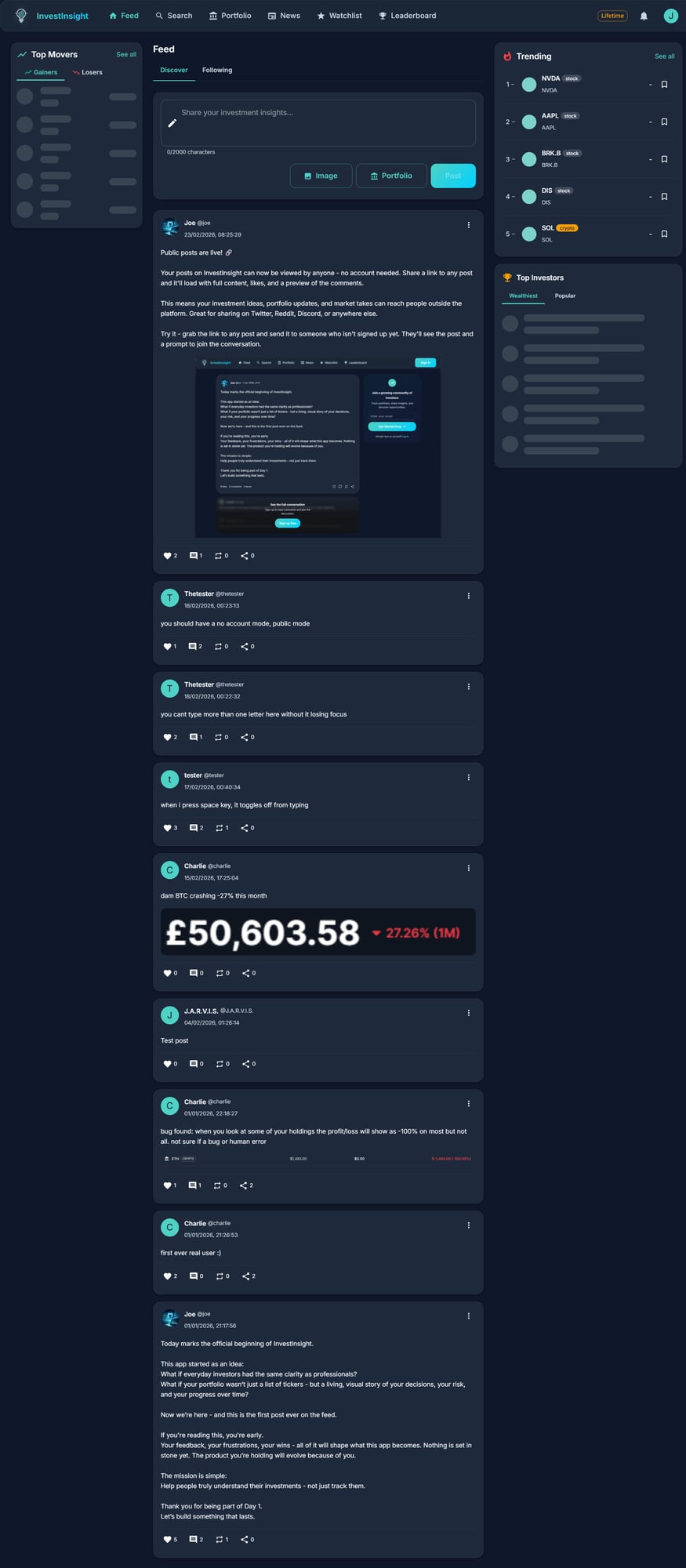
Investors can choose to make their portfolios public, giving you a transparent view of real holdings, allocation and how positions change over time. The social feed surfaces what the community is doing so you can spot patterns worth researching — while keeping every buy and sell decision firmly in your own hands.
Sentiment and leaderboard features
InvestInsight's sentiment and leaderboard features are designed to be read as gauges of community mood and interest, giving you context rather than instructions. They help answer “what is the crowd thinking?” so you can decide, thoughtfully, whether to agree or lean the other way.
Analysis to support your own judgement
Alongside the social layer, InvestInsight provides portfolio tracking and AI-assisted analysis to help you do the due diligence that social signals should always trigger. The aim is to close the loop: discover an idea socially, then investigate it properly, all in one place. If you are weighing your options, our comparison of InvestInsight vs Afterhour highlights how this learning-first philosophy differs from platforms built around the social feed alone.
Conclusion
Social investing, at its best, is a masterclass you can attend for free. By watching real portfolios — their allocation, their position sizing, their conviction, and yes, their mistakes — you can compress years of hard-won lessons into your own learning journey. But the same transparency that makes it powerful also makes it dangerous when misused. Survivorship bias, performance chasing, herd behaviour and hidden context are always lurking, ready to punish anyone who treats another person's portfolio as a shortcut around their own thinking.
The responsible path is straightforward: let other investors point you toward ideas, then do the work to decide for yourself. Use social signals as inputs, not commands, and never skip your own due diligence. Handled this way, the community becomes a genuine asset rather than a source of noise.
If you want to learn from real portfolios in a place designed for exactly that, explore InvestInsight's social investing features — follow investors you find thoughtful, study public portfolios, read the community's sentiment, and then make every decision your own. This article is for educational purposes only and is not financial advice.