
ISA vs SIPP: Where Should UK Investors Put Their Money in 2026?
Published: April 5, 2026
•Joseph Hughes
For UK investors trying to grow their money tax-efficiently, few decisions matter more than the ISA vs SIPP question. Both wrappers offer powerful tax advantages, but they work in fundamentally different ways — and the right choice depends on your goals, your timeline, and when you actually want to spend the money. This guide walks through how each account works, how they’re taxed, and why many investors end up using both.
Before we dig in, one important note: this article is educational and does not constitute financial or tax advice. Tax rules, allowances, and access ages change over time, and everyone’s circumstances differ. Always check current HMRC guidance or speak to a qualified adviser before making decisions.
Key Takeaways
| Question | Short, Practical Answer |
|---|---|
| What’s the core difference? | An ISA gives you tax-free growth and withdrawals; a SIPP gives you tax relief on contributions but taxes most withdrawals in retirement. |
| Which is more flexible? | The ISA — you can access your money at any age, for any reason. |
| Which is better for retirement? | The SIPP often wins for long-term retirement saving thanks to upfront tax relief and (usually) a tax-free lump sum. |
| Can I use both? | Yes — many investors combine them, and each has its own annual allowance. |
| When can I access the money? | ISA: any time. SIPP: only from a set minimum pension age, which is set by rules that can change. |
| Is this financial advice? | No. Check current HMRC rules or a regulated adviser for your situation. |
1. What Is a Stocks & Shares ISA?
An Individual Savings Account (ISA) is a tax wrapper that lets UK residents invest without paying tax on the returns. A Stocks & Shares ISA specifically holds investments — shares, funds, ETFs, investment trusts and similar — rather than cash.
The headline benefit is simple: once money is inside the ISA, you pay no UK tax on capital gains, dividends, or interest generated within it. When you take money out, there’s no tax to pay either, and you don’t even need to declare it on a tax return.
- Tax-free growth: gains and income inside the wrapper are sheltered from UK tax.
- Tax-free withdrawals: take money out whenever you like, with no tax charge.
- No minimum age to access: unlike a pension, there’s no lock-up until retirement.
- Annual allowance: there’s a yearly limit on how much you can pay in, which is set by the government and can change from year to year.
Because you fund an ISA with money you’ve already been taxed on (your take-home pay), there’s no upfront tax relief. The reward comes later, in the form of completely tax-free growth and flexible access.
2. What Is a SIPP?
A Self-Invested Personal Pension (SIPP) is a type of personal pension that gives you control over how your retirement savings are invested. Like a Stocks & Shares ISA, it can hold a wide range of investments — but it comes with the tax treatment and access rules of a pension.
The defining feature of a SIPP is tax relief on contributions. When you pay in, the government effectively tops up your contribution to reflect the income tax you already paid on that money. Higher and additional-rate taxpayers may be able to claim further relief, though the exact mechanics depend on your tax band and current rules.
- Tax relief going in: contributions are boosted by tax relief, which can significantly increase what you invest.
- Tax-deferred growth: investments grow free of UK capital gains and dividend tax inside the pension.
- Taxed on the way out: most of what you withdraw in retirement is treated as taxable income.
- Tax-free lump sum: you can typically take a portion (commonly described as up to 25%) as a tax-free lump sum, subject to limits and rules that can change.
A helpful way to remember it: an ISA is taxed before money goes in and tax-free thereafter, while a SIPP is largely tax-free going in and taxed when it comes out. The tax bill doesn’t disappear — it just moves to a different point in time.
3. Tax Treatment Compared
The heart of the ISA vs SIPP decision is when you pay tax. Neither wrapper is a magic tax eliminator; each simply changes the timing and structure of taxation.
The ISA: pay tax now, enjoy freedom later
You contribute from post-tax income, so there’s no upfront boost. In exchange, everything inside grows tax-free and every withdrawal is tax-free. There’s no distinction between contributions and growth when you take money out — it’s all yours, clean.
The SIPP: relief now, tax later
Contributions attract tax relief, which is a powerful head start — effectively investing money that would otherwise have gone to HMRC. Growth is sheltered. But when you draw an income in retirement, it’s generally taxable, aside from the tax-free lump sum portion. Whether you come out ahead often depends on your tax rate today versus your expected tax rate in retirement.
A common rule of thumb: if you expect to be a lower-rate taxpayer in retirement than you are now, the SIPP’s “relief now, tax later” structure can be especially attractive. But this is a generalisation, not a guarantee — rates and allowances change.
4. Access Age: The Big Practical Difference
This is where the two wrappers diverge most sharply in everyday terms.
- ISA: there’s no minimum age to access your money. You can withdraw at 30, 45, or 65 — whenever you need it, for whatever reason.
- SIPP: you cannot normally touch the money until you reach a set minimum pension age. That age is defined by government rules and has been scheduled to rise, so it’s essential to check the current threshold that will apply to you.
This difference shapes how the accounts fit into a plan. Money you might need before retirement — a house deposit, a career break, an emergency buffer beyond your cash savings — generally suits an ISA. Money you’re deliberately locking away for later life often suits a SIPP, where the lock-up is a feature, not a bug: it stops you raiding your retirement pot early.
5. Contribution Allowances
Both wrappers have annual limits on how much you can contribute, and both sets of limits are set by the government and reviewed periodically. Rather than quote figures that may be out of date, here’s the general shape:
- ISA allowance: there’s a total annual amount you can pay across your ISAs in a given tax year. Unused allowance generally doesn’t carry over — it resets each year.
- SIPP / pension allowance: there’s an annual limit on tax-relieved pension contributions, often linked to your earnings, plus lifetime and other rules that can apply. Some unused allowance from previous years may be usable under certain conditions.
Because these limits change — sometimes at each Budget — always confirm the current figures on GOV.UK or with an adviser before making large contributions. Treating stale numbers as current is one of the easiest mistakes to make.
6. Who Does an ISA Suit?
A Stocks & Shares ISA tends to appeal to investors who value flexibility and simplicity. Consider it if you recognise yourself here:
- You want tax-free growth and the ability to access your money before retirement.
- You’re saving for a medium-term goal — a property, a wedding, financial independence — not just old age.
- You prefer certainty: what you see is what you get, with no tax due on the way out.
- You’re earlier in your career, potentially a basic-rate taxpayer, and value optionality over maximum upfront relief.
The trade-off is that flexibility can be a double-edged sword. Because the money is easy to reach, it’s also easier to dip into and derail long-term goals. Discipline matters.
7. Who Does a SIPP Suit?
A SIPP tends to suit investors focused squarely on retirement, particularly those who benefit most from the tax relief:
- You’re confident this money is for later life and you won’t need it before pension age.
- You’re a higher or additional-rate taxpayer who can claim more generous relief now and may pay a lower rate in retirement.
- You’re self-employed or want to top up a workplace pension with your own investment choices.
- You like the idea of a built-in lock-up that protects your retirement pot from short-term temptation.
The main caveats are the access restrictions and the fact that most withdrawals are taxable. A SIPP rewards patience and a long horizon; it’s far less useful if you might need the cash sooner.
8. Using an ISA and a SIPP Together
For many people, the smartest answer to ISA vs SIPP isn’t “either/or” — it’s “both.” The two wrappers complement each other neatly because they solve different problems.
A common combined approach
- SIPP for retirement: capture the tax relief and let it compound for decades, deliberately out of reach.
- ISA for flexibility: build a tax-free pot you can tap before pension age, or use to bridge the gap between early retirement and the point you can access your pension.
Using both also gives you options in retirement itself. Drawing on ISA money (tax-free) alongside pension income (taxable) can help you manage your overall tax position year by year. Each wrapper has its own separate allowance, so contributing to one doesn’t use up the other — another reason the two work well as a pair.
Think of the ISA as your accessible, tax-free layer and the SIPP as your locked-away, relief-boosted retirement engine. Together they give you both reach and reward.
9. Keeping Track of Both Accounts in One Place
Here’s a practical challenge once you hold both an ISA and a SIPP — and perhaps a workplace pension and a general account too: your money ends up scattered across several providers, each with its own login, its own layout, and its own way of reporting performance. Getting a single, honest view of your overall position becomes genuinely hard.
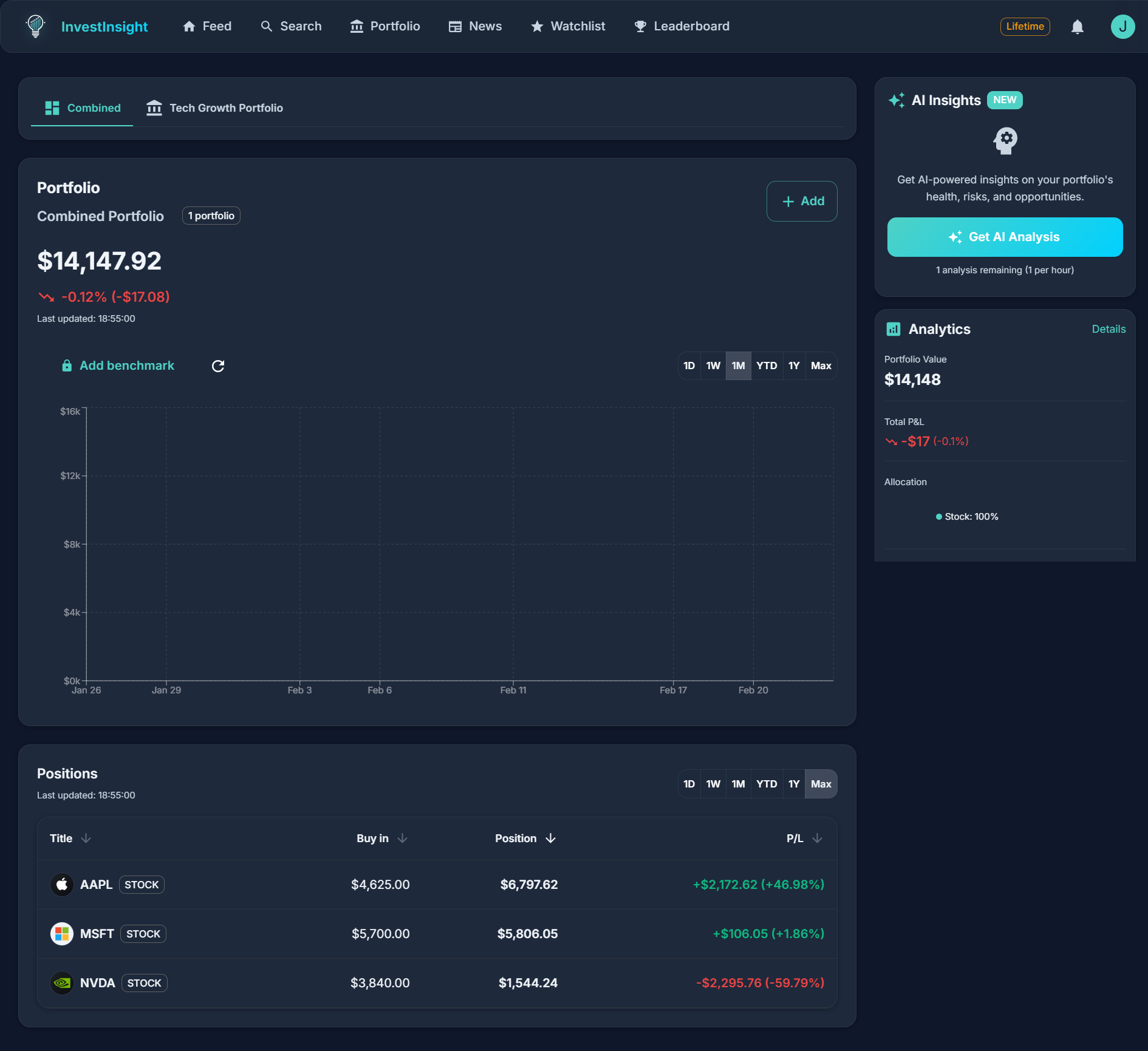
That’s exactly the problem InvestInsight is built to solve. You can create multiple portfolios — one for your ISA, one for your SIPP, and more — and see them side by side or combined. Our portfolio tracker pulls your holdings into one dashboard so you can monitor total value, asset allocation, and performance across every wrapper at a glance.
If income matters to you — and for retirement-focused investors it usually does — the dividend tracker helps you see the income your investments generate across accounts, so you can plan around it rather than guess. Add AI-powered analysis and the ability to follow other investors, and you have a full picture of your finances without juggling half a dozen tabs.
- See everything together: ISA, SIPP and beyond in one unified view.
- Separate when you want to: keep distinct portfolios so you always know which wrapper holds what.
- Track income: monitor dividends across accounts to support your retirement planning.
10. Common Pitfalls to Avoid
Whichever wrapper — or combination — you choose, a few mistakes crop up again and again:
- Assuming allowances are fixed: they change. Always verify the current year’s limits.
- Locking away money you’ll need soon: don’t over-fund a SIPP if you might need access before pension age.
- Ignoring the withdrawal tax on a SIPP: remember most pension income is taxable, so the relief isn’t a free lunch.
- Leaving cash uninvested: holding a Stocks & Shares ISA but never actually investing the money undermines the point.
- Forgetting the bigger picture: the “best” wrapper depends on your tax rate now versus later, your timeline, and your goals — not on which sounds better in the abstract.
Conclusion
The ISA vs SIPP debate rarely has a single winner. An ISA offers unbeatable flexibility and completely tax-free access, making it ideal for goals before and beyond retirement. A SIPP offers powerful upfront tax relief and a disciplined lock-up, making it a formidable retirement engine — provided you’re happy to wait. For a great many UK investors, the answer in 2026 is to use both, letting each do the job it’s best at.
Whatever you decide, the key is staying informed and keeping a clear view of everything you own. InvestInsight lets you track your ISA, SIPP and every other account together, with multiple portfolios, dividend tracking and AI-driven insight in one place. Try InvestInsight to bring your whole financial picture under one roof and make more confident decisions.
Important: This article is for education and general information only. It is not financial, investment, or tax advice, and it doesn’t account for your personal circumstances. Tax rules, allowances, reliefs, and pension access ages change and can differ by individual. Always check the current rules on GOV.UK / with HMRC, or consult a suitably qualified, regulated financial adviser, before acting. Investing carries risk and the value of investments can fall as well as rise.