
Index Funds vs ETFs: What's the Difference and Which to Choose?
Published: May 31, 2026
•Joseph Hughes
When you first start investing, the debate around index funds vs ETFs can feel surprisingly confusing — after all, both are cheap, passive ways to own a slice of the whole market. The truth is they are cousins rather than rivals: they often track the very same index, but they package it, price it, and trade it in different ways. This guide breaks down exactly what separates them so that, as a UK beginner, you can pick the passive vehicle that fits how you actually invest.
Key Takeaways
| Question | Short, Practical Answer |
|---|---|
| Are index funds and ETFs the same thing? | No. Both can track the same index passively, but an index fund is priced once a day while an ETF trades on an exchange throughout the day. |
| Which is cheaper? | Costs overlap heavily. ETFs can have lower headline fees, but platform charges and dealing fees often decide the real winner. |
| Which suits a regular monthly investor? | Index tracker funds usually win — free or cheap regular investing, fractional units, and no spread to worry about. |
| Which suits an active trader? | ETFs, because you can buy and sell at a live price during market hours. |
| Can I hold both in an ISA or SIPP? | Yes. Both index funds and ETFs are eligible for a Stocks & Shares ISA, SIPP, or general account. |
| Do I have to choose just one? | No. Many investors hold both, and a good portfolio tracker shows them side by side. |
1. What Are We Actually Comparing?
Before diving deeper into index funds vs ETFs, it helps to be precise about the terms, because the word “fund” gets used loosely in everyday conversation.
Both products are usually index-tracking — meaning they aim to mirror the performance of a market index (like the FTSE 100 or the S&P 500) rather than beat it. A human manager is not picking winners; the fund simply holds the constituents of the index in roughly the same proportions. This passive approach is why both tend to be low-cost. The real difference is not what they own, but how they are structured and traded.
Index tracker funds (OEICs and unit trusts)
In the UK, an index tracker fund is typically structured as an OEIC (Open-Ended Investment Company) or a unit trust. When you invest, you buy units directly from the fund provider. These are the “mutual funds” of the UK world. You do not trade them on a stock exchange.
ETFs (Exchange-Traded Funds)
An ETF holds a basket of assets in much the same way, but its shares are listed on a stock exchange such as the London Stock Exchange. That single structural choice — being listed — is the source of nearly every practical difference that follows.
2. The Big Difference: How and When You Trade
This is the distinction that matters most day to day.
- Index tracker funds are priced once per day. The provider calculates a single Net Asset Value (NAV) at a set “valuation point,” usually around midday or the market close. Every order placed that day — buy or sell — is filled at that one price. You will not know the exact price at the moment you press the button; you place the order and it settles later at the day’s NAV.
- ETFs trade continuously, like a share. Because they are listed, their price moves throughout the trading day in line with supply, demand, and the value of their underlying holdings. You can buy or sell at a live, visible price whenever the market is open.
If you value certainty and simplicity over control, once-a-day pricing is a feature, not a limitation — it removes the temptation to time the market minute by minute.
3. Minimums, Fractionals, and Regular Investing
For someone drip-feeding money in each month, the mechanics of buying matter enormously.
Index tracker funds
- Almost always support fractional units — you can invest a round pound amount (say £50) and receive a fractional slice of the fund. Every penny gets put to work.
- Many UK platforms let you set up free or very low-cost regular monthly investing into funds.
- There is no bid–offer spread to cross on most modern trackers, so what you see is broadly what you get.
ETFs
- Traditionally bought in whole shares, though a growing number of platforms now offer fractional ETF shares too.
- You typically pay a dealing (trading) fee each time you buy or sell, unless your platform offers commission-free ETF trades or a discounted regular-investment window.
- You cross a small bid–offer spread — the tiny gap between the buying and selling price — every time you deal.
For a beginner investing £100 or £200 a month, these small frictions add up, which is why funds often feel more forgiving for pound-cost averaging.
4. Accumulation vs Income Units
Whichever route you choose, you will meet another fork in the road: what happens to the dividends and interest the holdings generate?
- Accumulation (“Acc”) units automatically reinvest income back into the fund. You own the same number of units, but each one is worth a little more over time. This is the hands-off choice for long-term growth and compounding.
- Income (“Inc” or “Dist”) units pay the income out to you as cash, which you can spend, withdraw, or reinvest manually. This suits investors who want a stream of dividends.
Index tracker funds usually offer both Acc and Inc versions of the same fund. ETFs use similar labels — often accumulating versus distributing share classes. The concept is identical; only the naming and structure differ slightly.
5. Costs: TER, OCF, and the Real Total You Pay
Cost is where the index funds vs ETFs comparison gets nuanced, because there are several layers.
The fund’s own charge (OCF / TER)
Both funds and ETFs quote an ongoing charge, usually shown as the OCF (Ongoing Charges Figure) in the UK, sometimes still called the TER (Total Expense Ratio). This is the annual percentage the provider takes for running the fund. For broad, mainstream index trackers, these charges are generally very low — often a small fraction of a percent per year — and ETFs and index funds tracking the same market tend to land in a similar, competitive range.
Platform and dealing costs
The headline OCF is only part of the picture. On top of it you may pay:
- A platform fee to your broker or investment provider — sometimes a flat monthly fee, sometimes a percentage of your holdings.
- Dealing fees when buying or selling ETFs (funds are frequently free to trade).
- The bid–offer spread on ETFs.
The vehicle with the lowest OCF is not automatically the cheapest to own. On a percentage-fee platform, ETFs sometimes benefit from a fee cap; on a flat-fee platform, frequent ETF trading can rack up dealing charges. Always add the layers together.
6. Tracking Difference and Tracking Error
No passive fund mirrors its index perfectly. Two related ideas describe the gap:
- Tracking difference is how far the fund’s return diverges from the index over a period — usually slightly negative because of fees and costs.
- Tracking error measures how consistent that gap is (its volatility). A low, stable tracking error suggests the fund is doing its job reliably.
Neither index funds nor ETFs win this category by default. What matters is the quality of the specific product: how it is run, how it handles dividends and rebalancing, and how efficiently it holds its constituents. A well-run tracker of either type should hug its index closely.
7. Accessibility on UK Platforms
Practicality often decides the choice for real investors.
- Index tracker funds are the bread and butter of most UK fund supermarkets and pension platforms. They are easy to set up for regular investing, and fractional units make round-number contributions simple.
- ETFs are universally available on trading-focused platforms and apps, and increasingly on mainstream investment platforms too. If your provider is oriented around shares, ETFs may actually be the more natural fit.
Some platforms lean heavily toward one type or offer better pricing for one over the other, so it is worth checking your chosen provider’s fee schedule before committing to a strategy.
8. Tax Wrappers: ISA, SIPP, and General Accounts
Good news for beginners: on the tax question, index funds and ETFs are treated almost identically.
- Stocks & Shares ISA: Both index funds and ETFs can be held inside an ISA, sheltering gains and income from UK tax within your annual allowance. For most beginners, this is the natural first home for either vehicle.
- SIPP (pension): Both are eligible for a Self-Invested Personal Pension, benefiting from tax relief on contributions and tax-sheltered growth for retirement.
- General Investment Account: If you have used up your ISA and SIPP allowances, both can sit in a taxable general account, where Capital Gains Tax and dividend tax rules apply equally.
One small nuance worth knowing: certain overseas-domiciled ETFs may have specific reporting-status considerations for tax, but for mainstream UK-accessible, UK-reporting index products, the wrapper treatment is broadly the same. This is general information, not personal tax advice — if in doubt, speak to a qualified adviser.
9. Which Suits You: Regular Investor vs Trader?
Here is the heart of the decision, stripped back to intent.
You are a long-term, regular investor if…
- You invest a fixed amount each month and rarely check prices.
- You want fractional units so every pound is invested.
- You prefer simplicity and dislike the idea of watching intraday prices.
Leaning: Index tracker funds are typically the smoother ride. Once-a-day pricing and free regular investing suit patient, hands-off compounding.
You are an active or tactical investor if…
- You want to buy or sell at a known, live price.
- You value being able to react during market hours.
- You are comfortable with spreads and occasional dealing fees.
Leaning: ETFs give you that intraday control and are the standard tool for anyone who wants flexibility.
Crucially, this is not an either/or. A huge number of investors hold both — funds for the automated monthly core, ETFs for specific tactical exposures.
10. Common Index Exposures to Know
Whichever wrapper you pick, you will keep bumping into a handful of familiar index exposures. Understanding them (in general terms) helps you compare like with like.
- Global “all cap” type indices (for example, a FTSE Global All Cap approach) aim to capture thousands of companies across developed and emerging markets in one holding — a popular one-stop “whole world” option.
- S&P 500 exposure tracks 500 of the largest US companies — a common way to own the American large-cap market.
- FTSE 100 or FTSE All-Share exposure focuses on the UK market.
- Developed-world and emerging-market indices let you dial your geographic mix up or down.
The important point: the same index (say, the S&P 500) is usually available as both an index tracker fund and an ETF. So your choice between the two is genuinely about structure and platform mechanics — not about the underlying market you are buying.
11. Tracking Funds and ETFs Together with InvestInsight
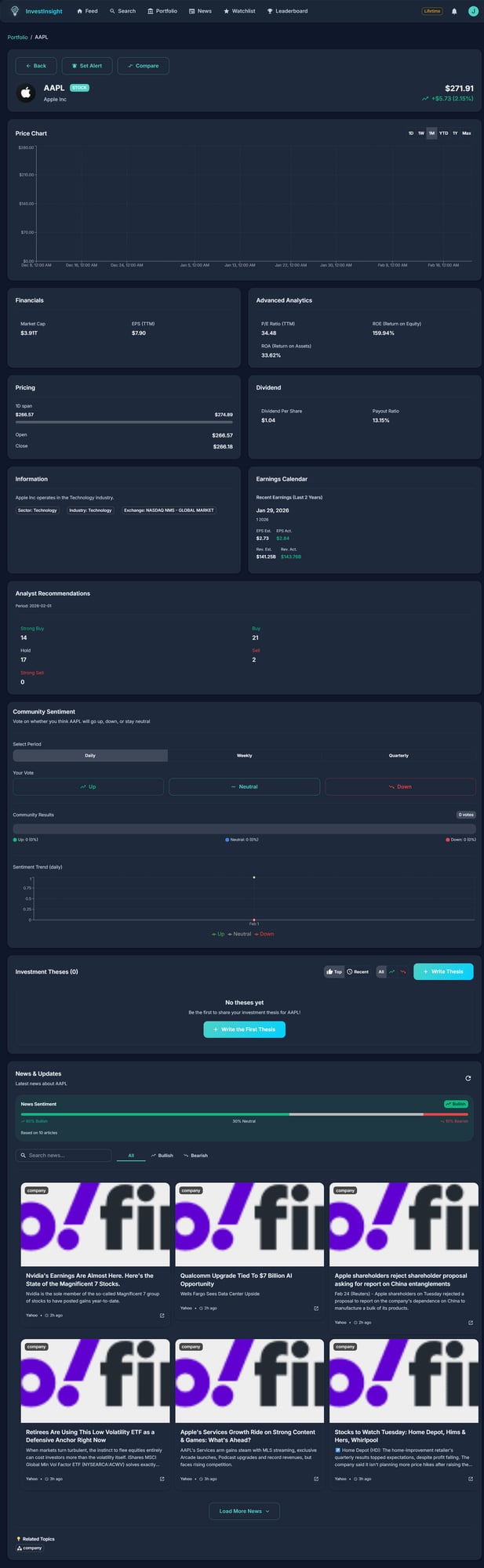
Once you hold a mix of index funds and ETFs — possibly across an ISA, a SIPP, and a general account — keeping a clear picture becomes the real challenge. That is exactly what InvestInsight is built for.
- See your index tracker funds and ETFs side by side in one unified view, regardless of structure.
- Track combined performance, allocation, and dividend income across every wrapper you use.
- Spot overlap — for instance, if a global fund and an S&P 500 ETF leave you doubly exposed to the same large US companies.
- Follow other investors, compare approaches, and layer on AI-driven analysis to understand what your passive portfolio actually holds.
Because InvestInsight treats funds and ETFs as first-class citizens together, you never have to mentally stitch two spreadsheets into one. Your whole passive core lives in a single, honest dashboard.
Conclusion
The index funds vs ETFs question rarely has one universal winner. Both give you cheap, diversified, passive exposure to the markets you care about. Index tracker funds shine for hands-off, regular monthly investing with fractional units and once-a-day simplicity; ETFs shine for live pricing and intraday flexibility. For most UK beginners building a long-term core, either is a perfectly sensible choice — and many end up owning both.
Whichever you choose, the key is to see your holdings clearly, understand your true costs, and keep an eye on overlap. Ready to bring your funds and ETFs into one place? Start with the InvestInsight portfolio tracker and watch your entire passive portfolio — funds, ETFs, dividends and all — come together in a single view.
This article is general information for UK investors and is not personal financial or tax advice. The value of investments can go down as well as up, and you may get back less than you invest.