
How to Track Crypto and Stocks in One Portfolio
Published: March 8, 2026
•Joseph Hughes
If you own Bitcoin in one app and shares in another, you don’t really know what your portfolio looks like. To track crypto and stocks together is to stop guessing at your true net worth and finally see how a hot coin or a big equity position tilts your whole allocation. This guide walks through why a unified view matters, how to consolidate holdings you’ve scattered across exchanges and brokers, and a simple monthly routine to keep everything honest.
Key Takeaways
| Question | Short, Practical Answer |
|---|---|
| Why put crypto and stocks in one place? | Only a combined view shows your true net worth, real allocation, and where you’re over-exposed. |
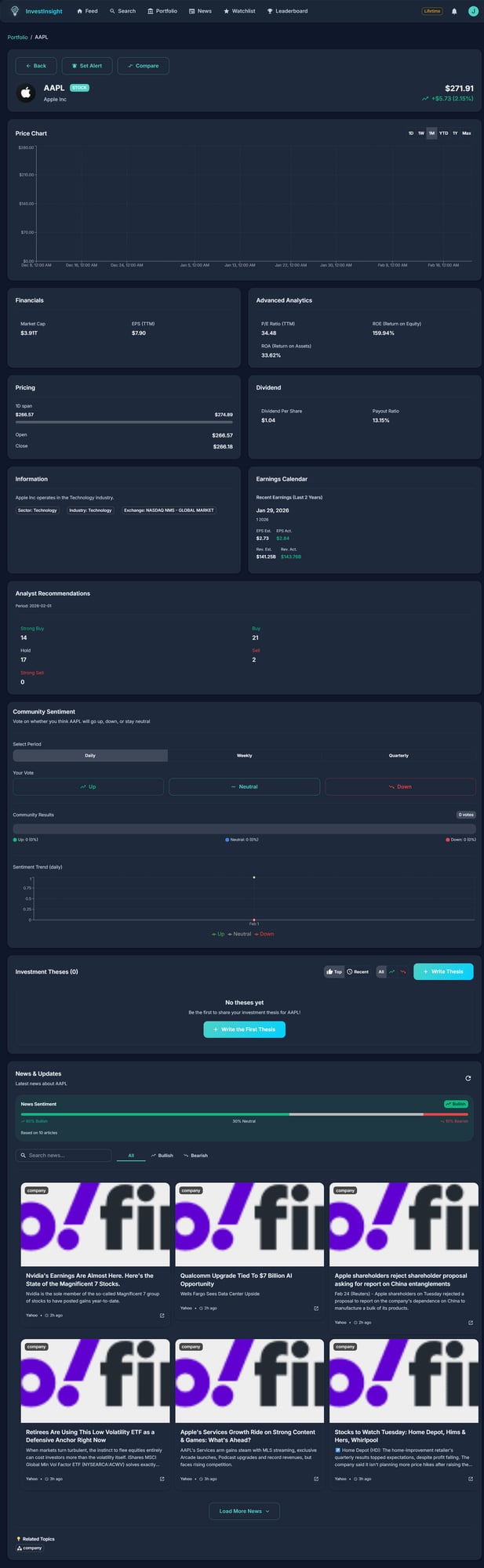
| How do I actually consolidate? | Add shares and coins to a single dashboard via manual entry or CSV import. InvestInsight supports both today. |
| Does InvestInsight auto-sync my exchange? | Not yet — crypto is manual or CSV for now, with exchange sync on the roadmap. Shares update on price automatically. |
| What’s the biggest risk to watch? | Concentration. When crypto runs hot, it can quietly become half your portfolio without you noticing. |
| What about UK tax? | Keep dated records of every buy, sell and disposal — crypto and shares can both trigger Capital Gains Tax. |
| How often should I review? | A 15-minute monthly check of allocation, drift and alerts is enough for most long-term investors. |
1. Why a Unified View Actually Matters
Most investors don’t start with a plan to spread their money across five apps — it just happens. You open a brokerage account for a stocks ISA, buy a bit of Bitcoin on an exchange because a friend mentioned it, pick up an ETF somewhere else, and suddenly your financial picture is scattered across a browser tab graveyard.
The problem is that no single one of those apps can answer the question that matters most: what am I actually worth, and how is it allocated? When you track crypto and stocks together, three things snap into focus:
- True net worth. Your investable wealth is the sum of everything, not the balance of whichever app you happen to have open.
- Real allocation. You might think you’re 90% equities and 10% crypto. A combined view often reveals you drifted to 70/30 during a rally.
- Correlation blind spots. Shares and crypto sometimes fall together. Seeing both on one screen makes it obvious when you’re less diversified than you assumed.
You can’t manage what you can’t see. An allocation you never measure is an allocation the market chooses for you.
2. The Problem With Siloed Apps
Each individual app is often excellent at its one job. The trouble is what happens between them.
Fragmented performance
Your exchange shows a green number, your broker shows a red one, and neither tells you whether you’re up or down overall. Gains in one silo can quietly mask losses in another, so you feel like you’re winning when you’re treading water.
Duplicated mental effort
Working out your total exposure means opening multiple apps, jotting figures on paper or into a spreadsheet, and hoping you didn’t fat-finger a decimal. Most people do this once, find it tedious, and never do it again — which is exactly when allocation drift creeps in.
No shared context
A crypto app has no idea you also hold a tech-heavy ETF. So when your ETF and your altcoins are both riding the same risk-on wave, nothing warns you that you’ve doubled down on a single theme without meaning to.
3. How to Consolidate: Manual Entry and CSV Import
Bringing everything into one place is less work than it sounds, and you only have to do the heavy lifting once. There are two reliable routes to get your holdings into a single portfolio tracker.
Manual entry
The simplest way to start. For each holding, you add the asset, the quantity, and roughly what you paid. This works beautifully for a handful of long-term positions — a few shares, an ETF or two, and your core coins. Because you type each entry deliberately, you also give yourself a moment to actually look at what you own.
CSV import
If you’ve been trading for a while, most exchanges and brokers let you export your transaction history as a CSV file. Importing that file brings in your positions in bulk instead of one at a time — far faster if you have dozens of trades behind you.
An honest note on syncing. InvestInsight currently supports manual entry and CSV import for crypto. Direct, automatic exchange sync — the kind that reads your balances live over an API — is on the roadmap, not something we do today. Share prices update automatically once a holding is in your crypto portfolio tracker and equity dashboard, but the initial crypto positions come from you. We’d rather be straight about that than promise a feature that isn’t live.
- Start with your biggest positions. Getting the top five holdings in gives you 90% of the insight for 20% of the effort.
- Use CSV for the long tail. Those small, half-forgotten trades add up — a bulk import catches them.
- Record cost basis where you can. It makes performance and tax record-keeping far easier later.
4. Position Sizing and Concentration Risk
This is the single most important reason to combine your holdings. Crypto is volatile in both directions, and when it runs hot it can balloon from a sensible slice into an outsized bet without you ever placing another trade.
Imagine you set out to hold 10% crypto. A strong bull run doubles or triples those coins while your shares stay flat. Suddenly crypto is 25–30% of your portfolio — a position you never consciously chose. If you only ever look at your crypto app, that number looks like a fantastic win. Viewed against your whole portfolio, it’s a concentration risk that could hurt badly on the way down.
Setting sensible limits
- Pick a target band, not a single number. “5–15% crypto” is easier to live with than a rigid 10%.
- Watch single-asset weight, too. One coin or one stock being 40% of everything is often riskier than the crypto-vs-equity split itself.
- Decide your rule in advance. Choosing a trim threshold while you’re calm beats reacting emotionally while prices swing.
InvestInsight’s AI concentration insight is built for exactly this. Because it can see your coins and shares in one dashboard, it can flag when a position has grown lopsided — the kind of drift that’s invisible when your assets live in separate apps.
5. Tax Record-Keeping (UK Context)
None of this is tax advice, and rules change — but good record-keeping is something every investor benefits from, and it’s far easier when everything lives in one place.
In the UK, both shares and crypto can fall under Capital Gains Tax when you dispose of them. A “disposal” isn’t just selling for cash. With crypto in particular, it can include:
- Selling a coin for pounds.
- Swapping one crypto for another.
- Using crypto to pay for goods or services.
That last point surprises people. Trading Bitcoin for Ethereum can be a taxable event even though no “real” money left your wallet. The practical takeaway is simple:
Keep a dated record of every buy, sell and swap — date, asset, quantity, and value in pounds at the time. Reconstructing this a year later, across multiple apps, is a genuinely painful job.
A consolidated portfolio makes that history far tidier. When your transactions live in one portfolio tracker, you have a single running log to hand your accountant or check against HMRC guidance — rather than exporting and stitching together five different files at year end. For anything specific to your situation, speak to a qualified tax professional.
6. Volatility and Rebalancing
Once you can see your real allocation, rebalancing becomes a calm, mechanical decision instead of a stressful guess.
What rebalancing actually is
Rebalancing means nudging your portfolio back toward your target weights. If crypto has grown from 10% to 25%, rebalancing might mean trimming some crypto and topping up shares to restore the balance. It quietly enforces the old discipline of selling a little of what’s expensive and buying a little of what’s cheap.
Two common approaches
- Calendar-based: review on a fixed schedule — say, quarterly — and adjust if you’ve drifted meaningfully.
- Threshold-based: only act when an asset class moves more than a set amount (for example, 5 percentage points) from its target.
Neither is “correct” — the point is to have a rule and follow it. Because crypto is so volatile, threshold-based rules can be especially useful: they keep you from either ignoring a huge run-up or fiddling with your portfolio every time the market twitches. And they only work if you can actually measure the drift, which loops back to having one combined view.
7. Using AI Analysis and Price Alerts
A unified dashboard isn’t just a tidier spreadsheet — it’s the foundation for tools that watch your portfolio so you don’t have to stare at it all day.
AI analysis
Because InvestInsight sees your entire portfolio — coins and shares side by side — its AI can surface things that are hard to spot manually: a position that’s quietly become too large, an allocation that has drifted from your intent, or an over-reliance on a single theme. Think of it as a second pair of eyes that never forgets to check.
Price alerts
Volatility cuts both ways, and nobody can watch the market around the clock. Price alerts let you set the levels that matter to you — a target you’d trim into, or a floor you’d want to know about — and get notified instead of doom-scrolling charts.
- Set alerts at your rebalancing thresholds so you hear about drift the moment it happens.
- Use them to remove emotion — a plan you set in advance is easier to follow than a snap decision at 2am.
- Cover both sides — alerts aren’t only for crashes; a big rally is exactly when concentration risk builds.
8. A Simple Monthly Routine
You don’t need to check your portfolio every day — for most long-term investors, obsessive monitoring does more harm than good. A short, consistent monthly review is plenty. Here’s a routine that takes about 15 minutes.
- 1. Update any new holdings. Add trades from the past month via manual entry or a quick CSV import so your view stays accurate.
- 2. Check your allocation. Look at the crypto-versus-equity split and your largest single positions. Has anything drifted outside your target band?
- 3. Read the AI insight. Let the concentration analysis flag anything lopsided you might have missed.
- 4. Review and reset alerts. Adjust price alerts to reflect where your holdings now sit.
- 5. Decide, then step away. Rebalance only if your rule says so — then close the app and get on with your life.
The goal of a routine isn’t to trade more. It’s to trade less, and more deliberately, because you already know exactly where you stand.
9. Bringing It All Together
Tracking crypto and shares in one portfolio isn’t about adding complexity — it’s about removing the fog. When your coins and stocks share a single dashboard, you get an honest net-worth figure, a real allocation you can act on, and early warning when a position runs hot. Everything else — sensible position sizing, cleaner tax records, disciplined rebalancing — flows from that one decision to stop looking at your money in fragments.
The apps you already use are good at their narrow jobs. The value comes from the layer on top: the view that ties it all together and tells you what to pay attention to.
Conclusion
You almost certainly already have the pieces — some shares, an ETF, a few coins. What’s usually missing is the single place that makes them add up to a picture you can actually manage. Pulling them together turns a scattered collection of balances into a portfolio you understand.
InvestInsight is built to be that place: one dashboard for coins and shares, AI concentration insight that spots when you’re over-exposed, and price alerts that watch the market for you. Crypto is manual or CSV for now, with exchange sync on the way — but you can bring your whole portfolio into a single view today. Start with your top few holdings, add the rest as you go, and try InvestInsight’s crypto portfolio tracker to finally see everything in one place.
This article is for general information only and is not financial or tax advice. Investing involves risk, and the value of investments can go down as well as up. For guidance specific to your circumstances, consult a qualified professional.