
How to Rebalance Your Portfolio Without Overtrading
Published: May 17, 2026
•Joseph Hughes
Learning how to rebalance your portfolio is one of the most valuable habits a long-term investor can build — but it is also one of the easiest to overdo. Rebalancing keeps your risk in check by nudging your holdings back toward your intended plan, yet done too often it quietly erodes returns through taxes, spreads and trading costs. This guide shows you how to keep your allocation on track while trading as little as possible.
Key Takeaways
| Question | Short, Practical Answer |
|---|---|
| What is rebalancing? | Returning your portfolio to its target mix of assets after markets have pushed it off course. |
| How often should I rebalance? | Once a year is plenty for most long-term investors, or when a holding drifts beyond a set band. |
| What is a threshold band? | A rule to only act when an asset moves more than, say, 5% away from its target weight. |
| How do I avoid overtrading? | Use new contributions and dividends to top up laggards instead of selling winners. |
| Does account type matter? | Yes — selling inside an ISA or SIPP has no tax drag, unlike a taxable account. |
| How do I spot drift early? | A live allocation view and concentration insight flag it before it becomes a problem. |
1. What Rebalancing Is — and Why It Matters
When you first build a portfolio, you choose a mix of assets that matches your goals and appetite for risk. You might decide on 60% global equities, 30% bonds and 10% in a satellite of crypto or individual stocks. That mix is your plan. The problem is that markets never stand still, so your carefully chosen weights start drifting the moment you stop looking.
Suppose equities enjoy a strong year and rise 25% while your bonds are flat. Your 60/30/10 split quietly becomes something closer to 68/24/8. You now own a riskier portfolio than the one you signed up for — without ever having made a decision to take on more risk. This is called risk drift, and it is the core reason rebalancing exists.
Rebalancing is not about chasing the best returns. It is about making sure the risk you carry today still matches the risk you chose when you had a clear head.
Knowing how to rebalance your portfolio properly means selling a slice of what has grown too large and topping up what has shrunk, bringing everything back toward your target. Done well, it enforces a disciplined "sell high, buy low" behaviour that most investors struggle to do by instinct.
2. The Two Main Approaches: Calendar vs Threshold
There are two established ways to decide when to rebalance, and understanding the difference is the first step to trading less.
Calendar rebalancing
With the calendar approach, you pick a fixed schedule — annually, or perhaps every six months — and review your portfolio only on those dates. On review day you check each holding against its target and correct any that have wandered. It is simple, predictable and easy to stick to.
- Pros: Effortless to remember, keeps you from tinkering, minimises the number of trades.
- Cons: A sharp market move between review dates can leave you off-target for months.
Threshold (band) rebalancing
The threshold approach ignores the calendar and instead sets a tolerance band around each target. A common choice is a 5% band: if your 60% equity target drifts below 55% or above 65%, you act; otherwise you leave it alone. Many investors combine the two — they check on a schedule but only trade if a holding has breached its band.
- Pros: You only trade when it genuinely matters, which naturally cuts down overtrading.
- Cons: Requires you to monitor allocations, or use a tool that watches them for you.
For most long-term investors, an annual review with a 5% band strikes the best balance. You look once a year, and you only reach for the sell button when something has drifted meaningfully. In many years, you will find you do not need to trade at all.
3. The Hidden Cost of Overtrading
The instinct to "fix" a portfolio the moment it drifts by a percent or two feels responsible, but frequent rebalancing carries real costs that compound against you over decades.
Trading costs and spreads
Every trade may carry a dealing fee, and every buy or sell crosses the bid–ask spread. Individually these look trivial, but a habit of monthly fiddling across a dozen holdings turns into a meaningful annual drag. Fewer, larger, well-timed trades almost always beat many small ones.
Tax drag in taxable accounts
This is the big one. In a taxable (General Investment Account) setting, selling a holding that has risen can crystallise a capital gain. In the UK, gains above your annual Capital Gains Tax allowance are taxable, so every unnecessary sale can trigger a bill you could have deferred indefinitely. Overtrading effectively pre-pays tax you might never have owed if you had simply held on.
A portfolio that is 3% off target and untaxed will often beat a "perfectly balanced" one that paid tax and fees to get there. Precision is not the goal — discipline is.
The takeaway: the tighter your rebalancing trigger, the more you trade, and the more you hand over in costs and tax. A wider band is not laziness — it is efficiency.
4. Rebalancing With New Money — The No-Sell Method
Here is the single most powerful technique for rebalancing without overtrading: use new money to buy the laggards instead of selling the winners.
If you contribute to your portfolio regularly — monthly, quarterly, or whenever a bonus lands — you can direct those fresh contributions toward whichever assets have fallen below target. Instead of selling your over-weight equities (and possibly paying tax), you simply buy more bonds until the balance is restored. No sale, no gain crystallised, no problem.
Dividends and interest count too
The same logic applies to income. Rather than automatically reinvesting every dividend back into the stock that paid it, you can pool your dividends and interest and deploy them toward your under-weight holdings. Over a year, contributions plus reinvested income are often enough to keep a growing portfolio in line without a single sell order.
- Direct new contributions to the asset furthest below its target weight.
- Redirect dividends rather than auto-reinvesting on autopilot.
- Only sell when inflows alone cannot close a band breach — usually in the largest portfolios.
This approach is especially potent early on. While your portfolio is still smaller than your annual contributions, you may almost never need to sell anything at all.
5. Where You Rebalance Matters: ISAs, SIPPs and Taxable Accounts
The account a holding sits in changes the maths entirely. This is general information rather than personal advice, but the principle is worth understanding.
Inside tax-sheltered wrappers
Within a Stocks & Shares ISA or a SIPP, buying and selling triggers no Capital Gains Tax and no dividend tax. That means you can rebalance freely inside these wrappers without any tax drag — the only cost is dealing fees and spreads. If you hold assets across several accounts, it usually makes sense to do the bulk of your selling-based rebalancing inside these shelters.
Inside taxable accounts
In a General Investment Account, every sale is a potential taxable event. Here the no-sell method from the previous section really earns its keep: lean on new contributions and dividends, and reserve actual sales for your ISA and SIPP wherever possible.
Rebalancing across the whole picture
Because your target allocation applies to your entire wealth — not each account in isolation — you can be strategic. If your bonds are under-weight, add them inside your SIPP; if equities are over-weight, trim them inside your ISA. A whole-portfolio view is what makes this kind of tax-aware placement possible, which is exactly where a good portfolio tracker pays for itself.
6. Concentration Risk: The Silent Drift
Not all drift shows up neatly as "too much equity." Sometimes the danger is buried inside a single position. A stock you bought years ago quietly grows into 20% of your portfolio, or three of your holdings all turn out to be big-tech names that rise and fall together. Suddenly your diversified portfolio is riding on a handful of correlated bets.
This is concentration risk, and it is easy to miss because each individual holding still looks reasonable. It is only when you step back and look at the totals — by position, by sector, by geography — that the imbalance becomes visible.
- Single-stock concentration: one name dominating your equity sleeve.
- Sector concentration: several holdings clustered in the same industry.
- Geographic concentration: a home-country bias toward UK or US shares.
- Factor concentration: holdings that all behave the same way in a downturn.
Rebalancing is your tool for managing this too. Trimming an over-grown position back toward a sensible cap protects you from having too many eggs in one basket — and again, using new money to grow the rest of the portfolio around it can dilute the concentration without a single sale.
7. A Simple Rebalancing Routine You Can Actually Follow
The best rebalancing plan is one you will stick to. Complexity is the enemy of consistency, so here is a straightforward routine built for long-term investors who want to trade as little as possible.
The annual checklist
- Pick a date. Choose one review day a year and put it in your calendar — a birthday or the new tax year both work well.
- Write down your targets. Know your intended weights before you look, so emotion does not rewrite the plan on the day.
- Compare actual vs target. Note which holdings have breached your 5% band, up or down.
- Check concentration. Flag any single position or sector that has grown uncomfortably large.
- Rebalance with inflows first. Direct pending contributions and pooled dividends to the laggards.
- Sell only if needed. If inflows cannot close the gap, trim inside your ISA or SIPP before your taxable account.
- Record what you did. A short note keeps you honest and makes next year’s review faster.
That is the entire routine. Notice how many steps come before any selling — that ordering is deliberate, and it is what keeps overtrading in check.
8. Common Mistakes to Avoid
Even disciplined investors trip over the same handful of errors. Watch for these.
- Rebalancing too often. Monthly tinkering feels productive but usually costs more than it saves.
- Chasing performance. Rebalancing means buying what has lagged, not piling into what is hot.
- Ignoring the tax bill. Selling in a taxable account without checking the gain first can be an expensive surprise.
- Forgetting cash. Idle cash is part of your allocation too — drifting cash weights count as drift.
- Rebalancing account by account. Your plan applies to the whole portfolio, not each pot in isolation.
- Never rebalancing at all. The opposite error — letting a portfolio run for a decade untouched can leave it dangerously lopsided.
9. How InvestInsight Helps You Spot Drift
Rebalancing without overtrading depends on one thing: knowing exactly how far you have drifted, across every account, before you act. That is precisely what InvestInsight is built to show you.
The allocation view
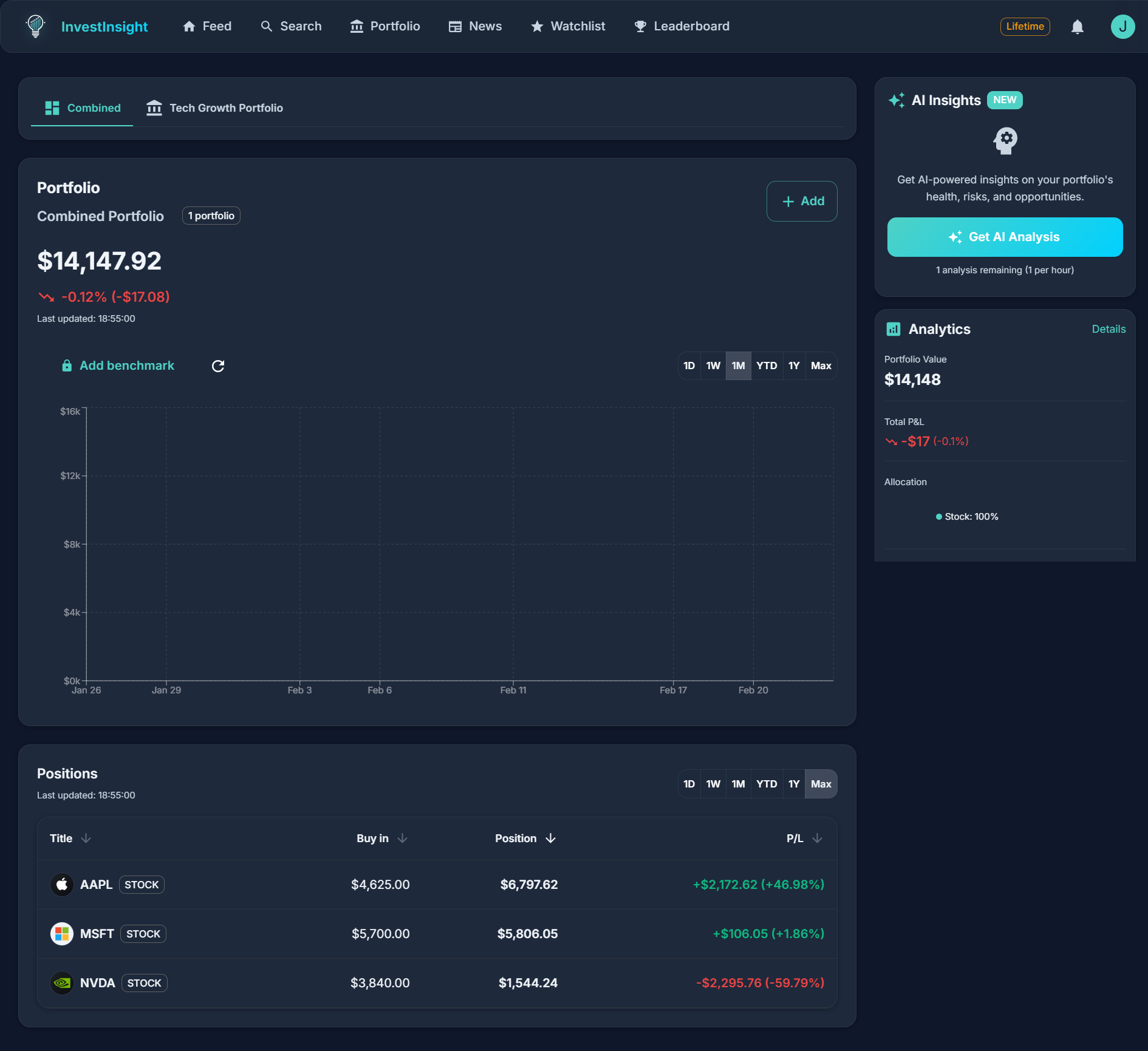
InvestInsight’s portfolio tracker gives you a single, live allocation view across all your holdings — ISAs, SIPPs and taxable accounts together. You can see at a glance how your actual weights compare to where you want them, broken down by asset class, sector and geography. Spotting a 5% band breach becomes a matter of seconds rather than a spreadsheet session.
AI concentration insight
Beyond the totals, InvestInsight’s AI concentration insight actively flags where you are becoming over-exposed — a single stock creeping toward too large a share, or a cluster of correlated holdings you might not have noticed. It surfaces the silent drift described earlier, so you can address it while it is still a minor adjustment.
The whole point of good tools is to make the right action obvious and the wrong action harder. Seeing your drift clearly is what lets you fix it with one deliberate trade instead of ten anxious ones.
With your allocation and concentration laid out in one place, your annual review becomes a five-minute check rather than a chore — and that is exactly the kind of low-effort, low-trading discipline that compounds in your favour over the years.
Conclusion
Rebalancing is not about perfection or precision timing — it is about staying honest to the plan you set when you were thinking clearly. Learning how to rebalance your portfolio the efficient way comes down to a few simple habits: review on a schedule, act only when a holding breaches a sensible band, lean on new contributions and dividends before you sell, and do your selling inside tax-sheltered wrappers wherever you can. Do that, and you capture the risk-control benefit of rebalancing while side-stepping the tax and cost drag that punishes the overtrader.
If you want to see your allocation and concentration clearly across every account — and catch drift before it turns into a problem — explore what InvestInsight’s portfolio tracker can do. It turns rebalancing from a spreadsheet chore into a quick, confident annual check.
This article is for general information only and does not constitute financial or tax advice. All figures are illustrative. Consider your own circumstances or speak to a qualified adviser before making investment decisions.