
Dollar-Cost Averaging vs Lump Sum Investing: Which Wins?
Published: March 22, 2026
•Joseph Hughes
The debate over dollar-cost averaging vs lump sum investing is one of the most common questions UK investors face when they have a chunk of cash to deploy — a bonus, an inheritance, ISA allowance at the start of the tax year, or the proceeds of a house sale. Do you invest it all at once and let the market do its work, or feed it in gradually to smooth out the bumps? The honest answer is that both approaches are defensible, and the “right” one depends as much on your temperament as on the maths.
Key Takeaways
| Question | Short, Practical Answer |
|---|---|
| Which usually wins on average? | Lump sum, because markets rise more often than they fall, so time in the market beats waiting. |
| When does DCA make more sense? | When you want to reduce regret, sleep better, or you simply don’t have a lump sum to invest. |
| Is DCA the same as regular investing? | Not quite — investing your monthly salary is regular investing by necessity, not a market-timing choice. |
| Can I combine both? | Yes — many investors lump sum part of the cash and drip-feed the rest over a few months. |
| What about my ISA? | Pound-cost averaging works well inside a Stocks & Shares ISA, keeping gains and dividends tax-free. |
| How do I track my average cost? | A portfolio tracker like InvestInsight shows your cost basis and running P&L automatically. |
1. What Do We Actually Mean by Dollar-Cost Averaging vs Lump Sum?
Before comparing them, it helps to pin down the definitions, because the terms get thrown around loosely. The core of the dollar-cost averaging vs lump sum decision is about timing: not whether to invest, but how quickly to put your money to work.
Lump sum investing
Lump sum investing means taking the whole amount you have available and investing it in one go. If you have £24,000 to put into a global index fund, you buy £24,000 of it today. Your money is fully exposed to the market from day one — for better or worse.
Dollar-cost averaging (DCA)
Dollar-cost averaging — known in the UK more often as pound-cost averaging — means splitting that same lump sum into equal instalments and investing them at regular intervals. Instead of £24,000 today, you might invest £2,000 a month for twelve months. When prices are high your fixed contribution buys fewer units; when prices are low it buys more. Over time this can lower your average purchase price relative to buying only at the peaks.
The key distinction: lump sum puts all your money to work immediately, while dollar-cost averaging deliberately keeps some of it on the sidelines and deploys it over time.
2. The Maths: Why Lump Sum Usually Wins on Average
Here is the uncomfortable truth for fans of drip-feeding. On average, across long stretches of market history, lump sum investing tends to outperform dollar-cost averaging the same amount of cash. The reason is simple and structural rather than clever.
Stock markets rise more often than they fall. Over any given year, a broad equity market is up more frequently than it is down, and over decades the long-term trend has been upward as economies grow and companies reinvest profits. If markets generally rise over time, then the sooner your money is invested, the more of that rise it captures.
Dollar-cost averaging, by design, holds part of your money in cash for months while you wait to invest the rest. During that waiting period, the un-invested portion typically earns only interest — and misses out on the market’s expected upward drift. Every month you delay investing a slice is, on average, a month of expected return you forgo on that slice.
- Time in the market is doing the heavy lifting, not timing the market.
- The longer your investing horizon, the more this effect compounds in favour of lump sum.
- The advantage is an average — it holds across many scenarios, not every single one.
Keep in mind these are illustrative principles, not a promise. Lump sum wins most of the time historically, but “most of the time” is not “always.” When the market falls right after you invest a lump sum, DCA would have done better. That possibility is exactly why the behavioural case matters.
3. The Behavioural and Risk Case for DCA
If lump sum wins on average, why does anyone dollar-cost average? Because investing is not a spreadsheet exercise carried out by a robot — it is done by humans who feel loss far more sharply than they enjoy gain.
Reducing the risk of terrible timing
The single biggest risk with lump sum investing is bad luck on entry. Invest your entire £24,000 the day before a sharp correction, and you are staring at a painful paper loss immediately. Dollar-cost averaging spreads that entry risk across several months, so no single day’s price dominates your outcome. You will never invest everything at the exact top — and, admittedly, never everything at the exact bottom either.
Smoothing volatility
By buying at multiple price points, DCA naturally dampens the impact of short-term volatility on your average cost. In a choppy, sideways market this can genuinely help, because your fixed contributions automatically buy more units when prices dip.
4. Regret Minimisation: The Real Reason DCA Feels Safer
Much of the appeal of dollar-cost averaging comes down to a concept behavioural economists call regret minimisation. Ask yourself which scenario would hurt more:
- You invest a lump sum, the market drops 15% next month, and you kick yourself for not waiting.
- You drip-feed slowly, the market climbs steadily, and you mildly regret not investing sooner.
For most people, the first scenario stings far more than the second. The pain of a visible, self-inflicted loss looms larger than the quieter disappointment of a missed gain. DCA is, in large part, an insurance policy against that sharper regret — and against the very real danger that a big early loss scares you into selling at the worst possible moment.
The best strategy is not the one that wins on a spreadsheet — it is the one you can actually stick to through a downturn without panicking.
An investor who lump sums, panics after a crash, and sells will do far worse than one who drip-fed calmly and stayed the course. If DCA keeps you invested and steady, its behavioural benefit can outweigh its statistical cost.
5. When Dollar-Cost Averaging Is the Only Sensible Choice
Here is a crucial point that often gets lost: for the majority of UK investors, dollar-cost averaging is not a market-timing decision at all — it is simply how investing from a salary works.
Investing from regular income
If you contribute a fixed sum from each month’s pay into a fund, you are dollar-cost averaging by necessity. You cannot lump sum money you do not yet have. This is the default reality for anyone building wealth out of earned income rather than a windfall, and it is a perfectly good way to invest.
- Contributions are automatic and consistent — you invest whether the market is up or down.
- It removes the temptation to time the market with each paycheque.
- It builds a disciplined habit, which for long-term investors is worth more than any single clever trade.
So the genuine dollar-cost averaging vs lump sum question really only applies when you already have a lump sum in hand and are choosing what to do with it. If your money arrives gradually, DCA is not a strategy you picked — it is just how your cash flow works, and that is fine.
6. Pound-Cost Averaging Inside a Stocks & Shares ISA
For UK investors, the vehicle matters as much as the method. Whichever approach you choose, doing it inside a Stocks & Shares ISA means your gains and dividends grow free of UK capital gains tax and dividend tax, within your annual ISA allowance.
Using your allowance efficiently
Some investors like to use their full ISA allowance early in the tax year with a lump sum, maximising tax-free time in the market. Others prefer to spread contributions across the year through pound-cost averaging, which is easier on the monthly budget and smooths out entry prices.
- Lump sum in April: gets money working tax-free from the start of the tax year.
- Monthly pound-cost averaging: fits regular income, smooths volatility, and is simple to automate.
Neither is wrong. If you have the cash and the stomach for it, front-loading your ISA has an edge on average. If a monthly direct debit is what keeps you consistent, that consistency is worth more than squeezing out the last fraction of expected return.
7. Combining the Two: A Practical Middle Ground
Real investing rarely fits neatly into one camp, and you do not have to choose one extreme. A popular compromise is to invest a portion as a lump sum and drip-feed the remainder over a defined, short window.
Example approaches
- Invest half your cash immediately, then split the other half across the next three to six months.
- Deploy a lump sum into lower-volatility holdings now, and dollar-cost average into more volatile positions.
- Set a fixed schedule — say six equal monthly instalments — and stick to it regardless of headlines.
The critical discipline with any phased approach is to pre-commit to a timetable and follow it mechanically. The failure mode of DCA is turning it into open-ended market timing — endlessly waiting for a “better” entry that may never come while your cash sits idle and misses the rise. A fixed end date protects you from that trap.
Decide your schedule in advance, write it down, and let the calendar — not the news — make your investment decisions for you.
8. Tracking Your Average Cost and Real Returns
Whichever path you take, you need to know where you actually stand. Dollar-cost averaging in particular makes your average purchase price harder to eyeball, because you buy at many different prices across many dates. Trying to reconstruct your true cost basis from a pile of contract notes is tedious and error-prone.
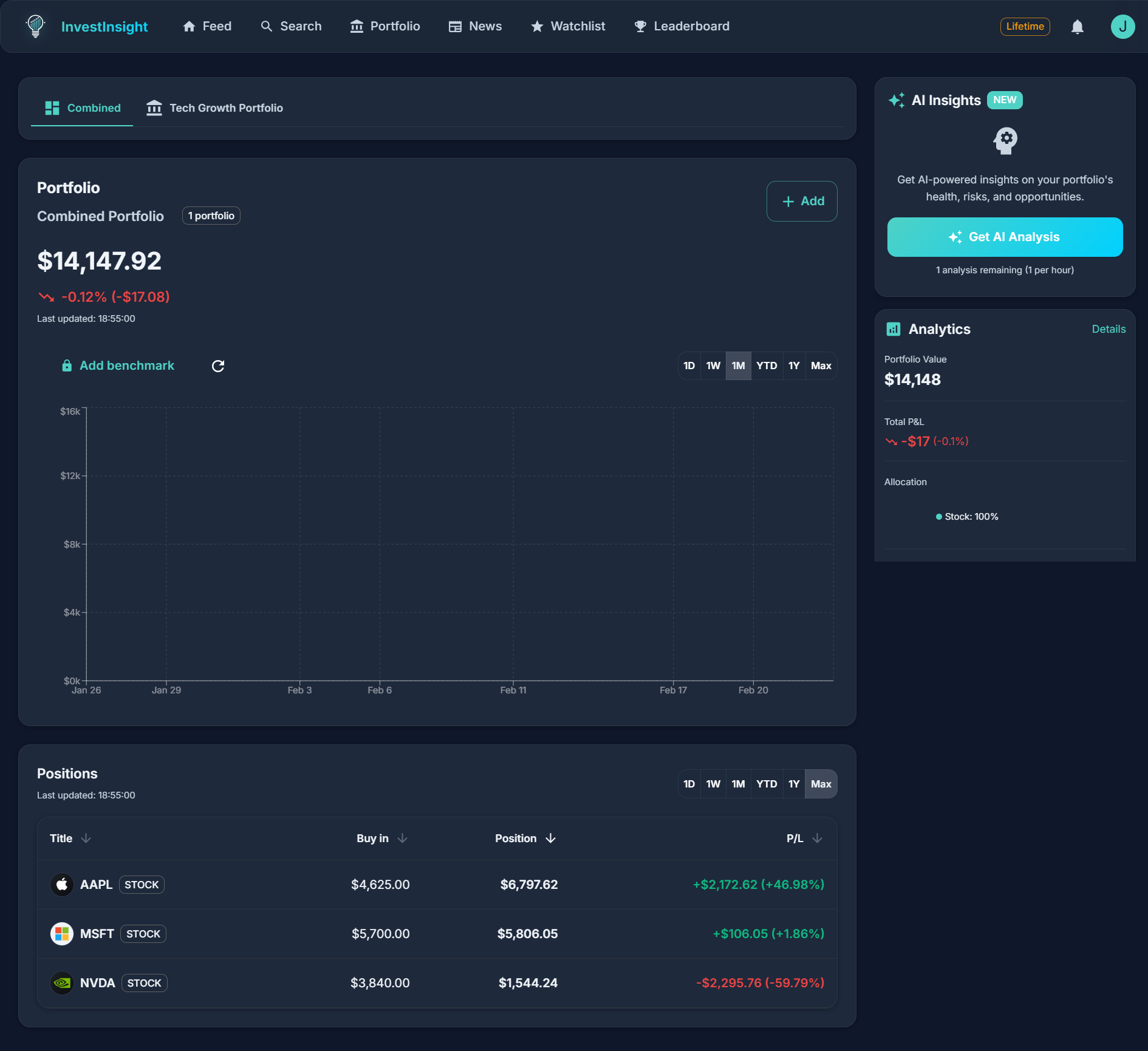
This is where a good portfolio tracker earns its keep. InvestInsight automatically calculates your average cost basis across every purchase, so you can see at a glance:
- The blended average price you have paid for each holding.
- Your unrealised profit and loss, updated as prices move.
- How each position and your whole portfolio is performing over time.
If you are drawing income from your investments, pairing this with a dividend tracker lets you see the cash your holdings generate alongside their capital growth — the full picture of what your money is doing, not just the share price. Seeing your real numbers also helps you stay rational: it is far easier to hold your nerve through a wobble when you can see your long-term average cost and overall gain rather than fixating on today’s red figure.
9. Common Mistakes to Avoid
Both approaches can be undermined by predictable errors. Watch out for these regardless of which side of the dollar-cost averaging vs lump sum debate you land on.
- Disguising market timing as DCA. If your “averaging” plan has no end date and keeps sliding, you are just timing the market and losing the discipline DCA is meant to provide.
- Letting cash sit uninvested indefinitely. Waiting for the perfect moment usually costs more in missed returns than it saves in avoided dips.
- Ignoring costs. If you pay a flat dealing fee per trade, splitting one purchase into twelve can rack up charges — commission-free regular investing avoids this.
- Panic-selling after a lump sum. The worst outcome is not a badly timed entry; it is bailing out at the bottom and crystallising the loss.
- Not tracking your position. Without a clear view of your cost basis and P&L, it is hard to make calm, informed decisions.
10. So, Which Should You Choose?
Put simply: if you have a lump sum, a long time horizon, and the emotional resilience to weather an early drop, the maths favours investing it all at once. Markets rise over time, and lump sum captures more of that rise.
But if the thought of investing everything the day before a crash would keep you awake — or worse, tempt you to sell in a panic — then dollar-cost averaging is a rational choice, even at a small expected cost. And if your money arrives with each payslip, you are dollar-cost averaging anyway, and doing exactly the right thing.
- Choose lump sum if you value expected return and can stay calm through volatility.
- Choose DCA if you value peace of mind, want to reduce regret, or invest from regular income.
- Combine them if you want a balance of both — just fix your schedule in advance.
This article is for general information only and is not financial advice. Your capital is at risk when you invest, and the value of investments can go down as well as up. If you are unsure what is right for your circumstances, consider speaking to a regulated financial adviser.
Conclusion
The dollar-cost averaging vs lump sum question does not have a single winner — it has a winner for you, depending on your cash, your horizon, and your temperament. Lump sum tends to win on the numbers because time in the market beats timing the market; DCA wins on behaviour because it keeps nervous investors invested and reduces the risk of regret. The best strategy is the one you can commit to and hold through a downturn.
Whatever you decide, the follow-through matters more than the philosophy. Track your contributions, know your average cost, and watch your real returns rather than the daily noise. Try InvestInsight to see your cost basis, profit and loss, and dividends in one place — and give your chosen strategy the clear, honest picture it deserves.