
Dividend Reinvestment (DRIP): How Compounding Builds Wealth
Published: May 3, 2026
•Joseph Hughes
Dividend reinvestment is one of the quietest, most powerful forces in long-term investing. Instead of taking your dividends as cash, you use them to buy more shares — which then pay their own dividends, which buy more shares again. Over years and decades, this compounding loop can turn a modest income portfolio into a meaningfully larger one, and understanding how it works is essential for any UK income investor deciding what to do with each payout.
This guide explains what a DRIP is, the maths behind the compounding, how automatic and manual reinvestment differ, the fee and tax points UK investors should know, and — importantly — when reinvesting might not be the right call.
Key Takeaways
| Question | Short, Practical Answer |
|---|---|
| What is a DRIP? | A Dividend Reinvestment Plan automatically uses your cash dividends to buy more shares of the same holding. |
| Why does it matter? | Reinvested dividends compound — new shares earn dividends too, accelerating growth over long periods. |
| Automatic or manual? | Automatic is hands-off and consistent; manual gives you control over where the cash goes. |
| Any costs? | Some brokers offer free DRIPs; others charge a small fee. Fractional shares help every penny stay invested. |
| Is it always right? | No — not if you need the income, are over-concentrated, or the holding looks overvalued. |
| Are reinvested dividends taxed? | Outside an ISA or SIPP, yes — reinvesting does not remove the tax liability. This is general information, not advice. |
1. What Is Dividend Reinvestment?
Dividend reinvestment is the practice of taking the cash a company or fund pays you and immediately using it to buy more of the same investment, rather than withdrawing it. When this happens automatically through your broker or fund provider, it is usually called a DRIP — a Dividend Reinvestment Plan.
Say you hold shares in a FTSE 100 dividend payer and it pays you £60 this quarter. With a DRIP in place, that £60 doesn’t land in your cash balance to be spent or forgotten. Instead, it buys roughly another £60 worth of the same shares. Next quarter, you own slightly more shares, so your dividend is slightly larger — and the cycle repeats.
The magic of a DRIP isn’t any single payment. It’s the fact that each reinvested dividend quietly increases the size of the next one, so your income grows even if the underlying dividend per share never changes.
This is the mechanism behind the well-worn phrase “total return.” The headline price of a share is only half the story; for income-focused UK investors, dividends reinvested over the years often account for a large share of the final outcome.
2. The Compounding Maths (An Illustrative Example)
Numbers make the idea concrete. The example below is entirely hypothetical and simplified — it assumes a fixed dividend yield, no share-price change, no fees, and no tax. Real markets never behave this neatly. It exists only to show the shape of compounding, not to predict returns.
Imagine you invest £10,000 in a holding with a steady 4% dividend yield, and you hold it for 20 years.
Scenario A: You take the dividends as cash
- Each year you receive 4% of £10,000 = £400 in cash.
- Over 20 years, that’s 20 × £400 = £8,000 in total dividends spent or saved elsewhere.
- Your original holding is still worth £10,000 (price unchanged in this simplified model).
- Combined position: £18,000.
Scenario B: You reinvest every dividend
- Year 1 pays £400, which is reinvested, taking your holding to £10,400.
- Year 2 pays 4% of £10,400 = £416, taking you to £10,816.
- Each year the base grows, so each dividend is a little larger than the last.
- After 20 years of compounding at 4%, £10,000 grows to roughly £21,900.
In this stylised comparison, reinvesting leaves you with around £21,900 versus £18,000 — a difference of nearly £3,900, purely from letting the dividends buy more shares. And crucially, the gap widens the longer you stay invested, because compounding accelerates over time.
Extend the same hypothetical to 30 years and the reinvested pot grows to roughly £32,400, while the cash-taken version sits at £22,000 (the original £10,000 plus 30 × £400). The extra decade does far more heavy lifting than the first — that is compounding’s signature curve.
3. Why Time Is the Most Important Ingredient
The illustrative figures above hint at something worth stating plainly: compounding rewards patience above almost everything else. A DRIP running for five years is pleasant; one running for twenty-five years can be transformative.
This has a practical implication. If you are decades from needing the money — building toward retirement, say — the case for reinvesting is strong, because you are giving the compounding curve room to steepen. If your time horizon is short, the benefit is smaller and other considerations (like needing the cash) may dominate.
- Start early. A dividend reinvested in your thirties has far longer to multiply than one reinvested in your sixties.
- Stay consistent. Interrupting reinvestment resets some of the momentum.
- Reinvest the whole payout. Fractional shares (covered below) let even small amounts stay working rather than sitting idle.
4. Automatic vs Manual Reinvestment
There are two broad ways to reinvest, and each suits a different temperament.
Automatic reinvestment (a true DRIP)
You switch it on once, and your broker or fund provider reinvests every dividend into the paying holding without you lifting a finger. Its strengths are consistency and discipline — the cash never sits around tempting you to spend it, and you never miss a reinvestment because you were busy.
- Best for: long-term, hands-off investors who want set-and-forget compounding.
- Trade-off: you lose flexibility — every dividend goes straight back into the same holding, even if you’d rather deploy it elsewhere.
Manual reinvestment
Here, dividends land as cash and you decide what to do with them — top up the same holding, buy something else, or rebalance the portfolio. Many investors pool dividends across the portfolio and reinvest them where the opportunity looks best.
- Best for: investors who want control and are happy to manage cash actively.
- Trade-off: it takes discipline and attention; idle cash and forgotten payouts are the enemy of compounding.
Automatic reinvestment removes the behavioural risk that you simply forget. For many people, “done automatically” beats “done perfectly but occasionally” — consistency is what compounding feeds on.
5. Broker DRIP Options in the UK
Most major UK investment platforms offer some form of dividend reinvestment, though the details vary. Rather than naming specific providers, here is what to look for when you check your own broker’s DRIP settings.
- Availability. Many UK brokers offer automatic reinvestment on shares, investment trusts and funds — but not always on every instrument. ETFs, for example, may be treated differently from individual shares.
- How it’s triggered. Some platforms reinvest each dividend as it arrives; others batch cash and reinvest on set dates or once a minimum threshold is reached.
- Where to switch it on. DRIP is usually a per-account or per-holding setting in your platform’s dividend or account preferences.
- Accumulation funds as an alternative. Many funds and some ETFs offer “accumulation” (Acc) share classes that reinvest income internally, so you don’t need a broker DRIP at all — the reinvestment happens inside the fund.
Always check the specific terms with your provider, as features, thresholds and eligible instruments differ from platform to platform.
6. Fees and Fractional Shares
Costs can quietly erode the benefit of reinvesting, so they’re worth understanding.
Reinvestment fees
Some UK brokers offer automatic reinvestment free of charge; others levy a small fee per reinvestment (sometimes a flat pence-per-holding charge, sometimes a percentage). On small dividends, even a modest flat fee can take a noticeable bite, so it pays to know what you’re being charged.
Fractional shares
Dividends rarely divide neatly into whole share prices. If a payout is £60 but a share costs £27, you can only buy two whole shares (£54) and the remaining £6 sits as cash — not compounding. Fractional share reinvestment solves this by letting you buy 2.22 shares, keeping every penny invested.
- Check for fractional support. Platforms that reinvest into fractional shares keep more of your money working.
- Mind small holdings. If fractions aren’t supported, tiny positions may never reinvest efficiently, and leftover cash accumulates.
- Weigh fees against amounts. A fee that’s trivial on a £500 dividend may be significant on a £15 one.
7. When NOT to Reinvest Dividends
Reinvesting is powerful, but it is not automatically the right choice. There are sound reasons to take dividends as cash instead.
You need the income
If you are retired or otherwise relying on your portfolio to fund living costs, dividends are doing their job as income. Reinvesting income you actually need — and then having to sell shares later to cover expenses — often makes little sense. For income-drawdown investors, taking the cash is frequently the whole point.
Over-concentration
A DRIP funnels every dividend back into the same holding. If that holding is already a large slice of your portfolio, reinvesting makes it larger still, increasing your exposure to a single company or sector. In that case, manual reinvestment into under-weighted areas can keep you diversified.
The holding looks overvalued
Automatic reinvestment buys more shares regardless of price. If you believe a holding is expensive or its outlook has deteriorated, mechanically buying more may not be sensible — you might prefer to direct the cash elsewhere.
A DRIP is a discipline, not a judgement. It buys more shares whether they’re cheap or dear, well-run or wobbling. That consistency is a strength for long-term index-style holdings, but a reason to stay alert with concentrated single-stock positions.
8. Tax: Reinvested Dividends Are Still Dividends
This is a point many UK investors miss, so it’s worth being clear. Reinvesting a dividend does not make it tax-free. Outside a tax-sheltered wrapper such as an ISA or SIPP, a dividend that is reinvested is still a taxable dividend in the eyes of HMRC — you are taxed as though you received the cash, because for tax purposes you did.
- Inside an ISA or SIPP: dividends (reinvested or not) are sheltered from UK dividend tax.
- In a general investment account: reinvested dividends count toward your dividend income for the year and may be taxable above the dividend allowance.
- Keep records: reinvestment also affects the cost basis of your holding, which matters for capital gains calculations later.
This is general information, not tax advice. Allowances and rates change, and everyone’s circumstances differ — check the current rules or speak to a qualified adviser before making decisions.
9. Tracking Reinvested Dividends and Forecasting Income
Reinvestment quietly complicates your record-keeping. Every reinvested payout adds a small parcel of shares at a new price, so over the years a single holding becomes a patchwork of little purchases. Tracking that by hand is tedious and error-prone — which is exactly where good tooling earns its keep.
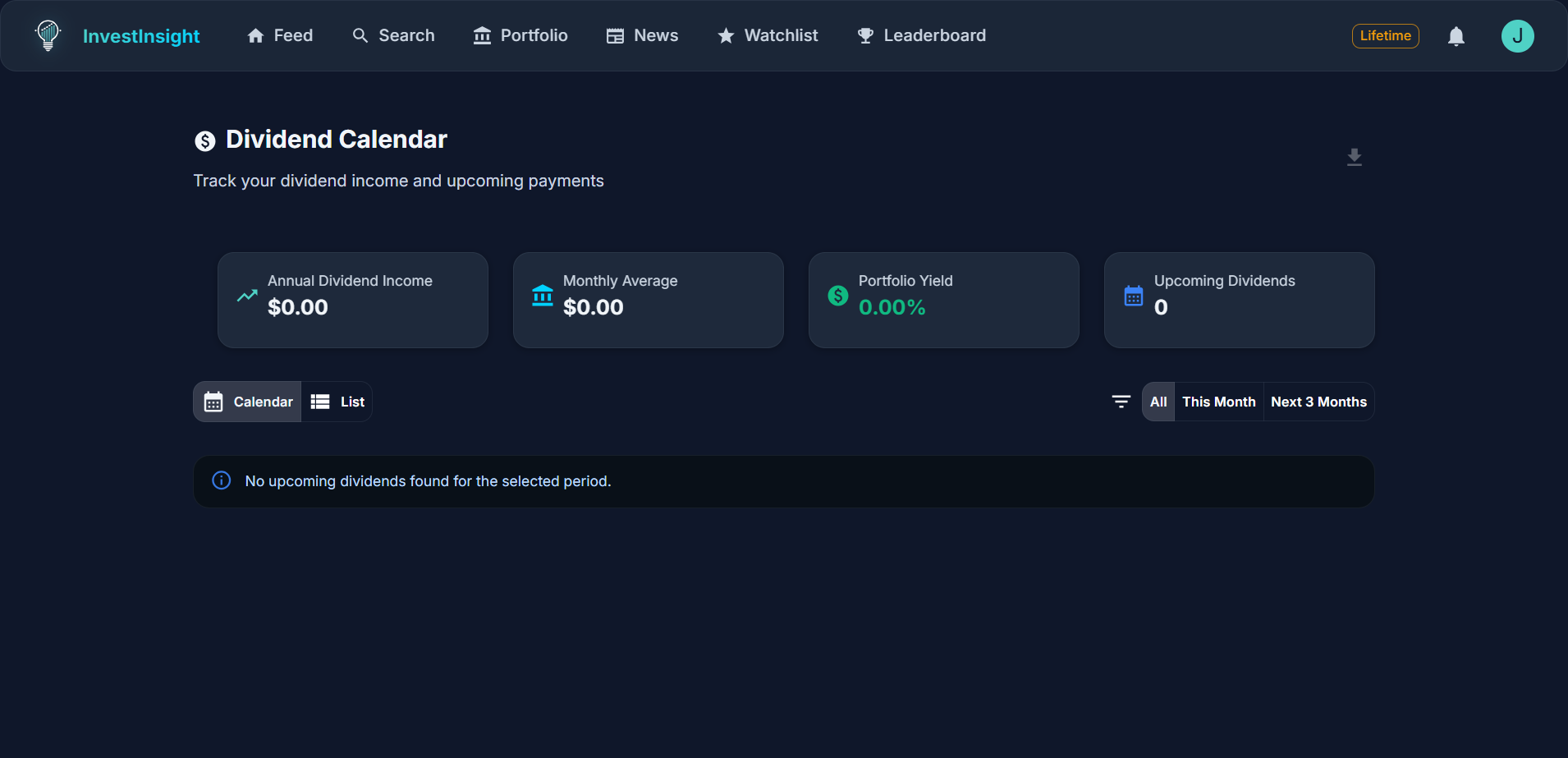
InvestInsight’s dividend tracker is built for this. It records each dividend, shows how reinvestment is growing your position over time, and gives you a clear view of your income — both what you’ve received and what’s coming.
- See your growing income. Watch how reinvested dividends steadily lift your projected payouts, so the compounding effect becomes visible rather than abstract.
- Forecast with the dividend calendar. Plan ahead by seeing upcoming ex-dividend and payment dates across your holdings in one place.
- Keep the whole picture. Your portfolio tracker ties dividends together with valuations, allocation and performance, so you can spot over-concentration before a DRIP quietly makes it worse.
Being able to see your income compounding — and to forecast next year’s payouts — turns dividend reinvestment from a background process into something you can actively steer.
10. A Simple Framework for Deciding
Pulling it together, here is a plain-English way to decide whether to reinvest a given dividend.
- Do I need this income now? If yes, take the cash. If no, reinvesting is on the table.
- Is my time horizon long? The longer you can leave it, the stronger the case for compounding.
- Is the holding already too large? If so, consider reinvesting elsewhere to stay diversified.
- Am I comfortable buying more at today’s price? If not, direct the cash where you’d rather deploy it.
- Is it inside a tax wrapper? Reinvesting inside an ISA or SIPP keeps things simple; outside, factor in the tax point.
Conclusion
Dividend reinvestment is a genuinely powerful wealth-building tool because it lets your income earn income — and given enough time, that compounding curve can do remarkable work, as our illustrative example showed. But it is a tool, not a rule. The right choice depends on whether you need the income, how concentrated your portfolio is, what a holding is worth today, and how the tax treatment applies to your situation.
The best way to make that decision well is to see clearly what your dividends are doing. Track your dividends and forecast your income with InvestInsight’s dividend calendar — and watch your reinvested payouts compound in real time, right alongside your full portfolio tracker.
This article is general information for UK investors and is not financial or tax advice. The figures used are hypothetical illustrations only and do not predict actual returns. Investments can fall as well as rise, and past performance is no guide to the future.