
Dividend Investing for Beginners: A UK Guide for 2026
Published: February 8, 2026
•Joseph Hughes
Dividend investing UK is one of the most approachable ways to start building a stream of passive income from the stock market. Instead of relying purely on share prices rising, you collect regular cash payments from companies that share their profits with shareholders. This guide walks UK beginners through everything from what a dividend actually is to building a reliable income calendar – without the jargon.
Key Takeaways
| Question | Short, Practical Answer |
|---|---|
| What is a dividend? | A cash payment a company makes to shareholders, usually from its profits, typically paid quarterly or twice a year. |
| Is a high yield always good? | No. A very high yield can signal a struggling company or a dividend that may be cut. Always check sustainability. |
| How do I invest tax-efficiently in the UK? | A Stocks & Shares ISA shelters dividends and gains from tax, up to the annual ISA allowance. |
| Should I reinvest dividends? | Reinvesting (DRIP) harnesses compounding and can significantly boost long-term returns if you don’t need the income now. |
| How do I stay organised? | Build a dividend calendar so you know when payments arrive and can forecast your annual income. |
| What’s the biggest beginner mistake? | Chasing yield without checking whether the company can actually afford to keep paying it. |
1. What Are Dividends, Really?
When a company earns a profit, it has choices about what to do with that money. It can reinvest in growth, pay down debt, buy back its own shares – or return some of it directly to shareholders as a dividend. If you own shares in a dividend-paying company, you receive a cash payment simply for holding the stock.
In the UK, many established firms pay dividends twice a year (an interim and a final dividend), while a lot of US-listed companies pay quarterly. There are a few key dates worth knowing:
- Declaration date – when the company announces the dividend.
- Ex-dividend date – you must own the shares before this date to qualify for the payment.
- Record date – the day the company checks its register of shareholders.
- Payment date – when the cash actually lands in your account.
The reason dividend investing UK strategies appeal to so many beginners is simple: they turn a portfolio into something that pays you regularly, rather than an asset you only benefit from when you sell.
2. Yield vs Total Return: Don’t Confuse the Two
The dividend yield is the annual dividend divided by the current share price, expressed as a percentage. If a share costs £10 and pays 40p a year in dividends, the yield is 4%. Yield is useful, but it’s only half the picture.
Why total return matters more
Total return combines two things: the income you receive from dividends and any change in the share price. A stock with a modest 3% yield that grows its share price and its dividend over time can easily out-perform a stock with a flashy 9% yield that’s slowly sinking.
A high yield is sometimes a reward for a great company at a fair price – and sometimes a warning that the market expects the dividend to be cut. Your job as an investor is to tell the difference.
Beware the “yield trap”: when a share price falls sharply, the yield mechanically rises. A 12% yield often means the market has already priced in trouble. Treat any unusually high figure as a question to investigate, not a bargain to grab.
3. Dividend Cover and Sustainability
The most important question in income investing isn’t “how big is the dividend?” but “can the company keep paying it?” Two simple checks help here.
Dividend cover
Dividend cover measures how many times a company’s earnings could pay its dividend. It’s calculated as earnings per share divided by dividend per share. As a rough guide:
- Cover above 2x – comfortable; the company earns roughly twice what it pays out.
- Cover around 1.5x–2x – generally healthy for a stable business.
- Cover below 1x – the company is paying out more than it earns, which usually isn’t sustainable for long.
Look beyond the ratio
Cover is a starting point, not the whole story. Also consider:
- Free cash flow – dividends are ultimately paid in cash, so a company that consistently generates more cash than it distributes is on firmer ground.
- Debt levels – a heavily indebted company may be forced to choose between its lenders and its shareholders.
- Payout history – has the dividend held up (or grown) through tougher years, or has it been cut before?
4. Dividend Growth vs High Yield
There are two broad philosophies in income investing, and understanding the difference helps you build a portfolio that suits your goals.
Dividend growth (“aristocrats”)
So-called dividend aristocrats are companies with a long track record of raising their dividend year after year. Their current yield might be modest – say 2% to 4% – but a rising payout means your income can grow steadily over time, often outpacing inflation. This approach rewards patience.
High yield
High-yield stocks pay out more today but often grow more slowly, and they can carry higher risk. Some sectors – utilities, tobacco, certain financials and real estate investment trusts – are traditionally higher-yielding. They can play a valuable role, but they need closer monitoring for sustainability.
Many beginners find a blend works best: a core of dependable dividend-growers with a smaller, carefully chosen allocation to higher-yield names. Diversifying across sectors also reduces the chance that one industry’s downturn wipes out a big chunk of your income.
5. ISAs and Tax-Efficient Dividends
How you hold your investments matters as much as what you hold. In the UK, a Stocks & Shares ISA is the workhorse of tax-efficient investing. Dividends and capital gains generated inside an ISA are sheltered from tax, and you can contribute up to the annual ISA allowance each tax year.
Outside an ISA (or a pension), dividends are covered by a separate dividend allowance – a tax-free band that applies before dividend tax rates kick in. The size of this allowance has been reduced over recent years, which makes sheltering income inside an ISA increasingly attractive for many investors.
- Using an ISA can mean you don’t have to track or report dividend income for tax on those holdings.
- Allowances, thresholds and rates change from year to year, so it’s worth confirming the current figures on GOV.UK before you plan.
Please note: this article is educational and general in nature – it is not personalised financial or tax advice. Tax treatment depends on your individual circumstances, and rules can change. If you’re unsure, consider speaking to a qualified adviser.
6. Reinvesting Dividends and the Power of Compounding
Here’s where dividend investing quietly becomes powerful. When you reinvest your dividends – buying more shares with each payment rather than spending the cash – those new shares generate dividends of their own. This is compounding, and over years and decades it can transform returns.
What is a DRIP?
A Dividend Reinvestment Plan (DRIP) automatically uses your dividend payments to buy additional shares, often without dealing charges. Many UK brokers offer this feature. The appeal is twofold:
- You keep your money working instead of leaving small cash balances idle.
- You buy consistently over time, smoothing out the price you pay (a form of pound-cost averaging).
The trade-off is straightforward: reinvesting builds your pot faster, while taking the cash gives you income to spend now. Younger investors in the accumulation phase often reinvest; those in or near retirement may prefer to draw the income. There’s no single right answer – it depends on your goals.
7. Building a Dividend Calendar
As your portfolio grows, keeping track of who pays what and when becomes surprisingly tricky. Different companies pay at different times of year, in different currencies, and on different schedules. A dividend calendar solves this.
What a good calendar shows you
- Upcoming payments – which holdings pay in the next week, month or quarter.
- Ex-dividend dates – so you know the deadline to own a share and qualify for the next payout.
- Projected annual income – a forecast of the total dividends your current holdings should generate over a year.
- Income concentration – whether too much of your income depends on a single company or sector.
Building this by hand in a spreadsheet is possible, but it’s fiddly to maintain – especially once you hold a mix of UK, US and international shares that pay on different calendars.
8. How InvestInsight Helps With Dividend Tracking
This is exactly the kind of admin that InvestInsight is built to take off your plate. Rather than updating a spreadsheet every time a company announces or pays a dividend, you can see it all in one place.
The dividend calendar and income forecast
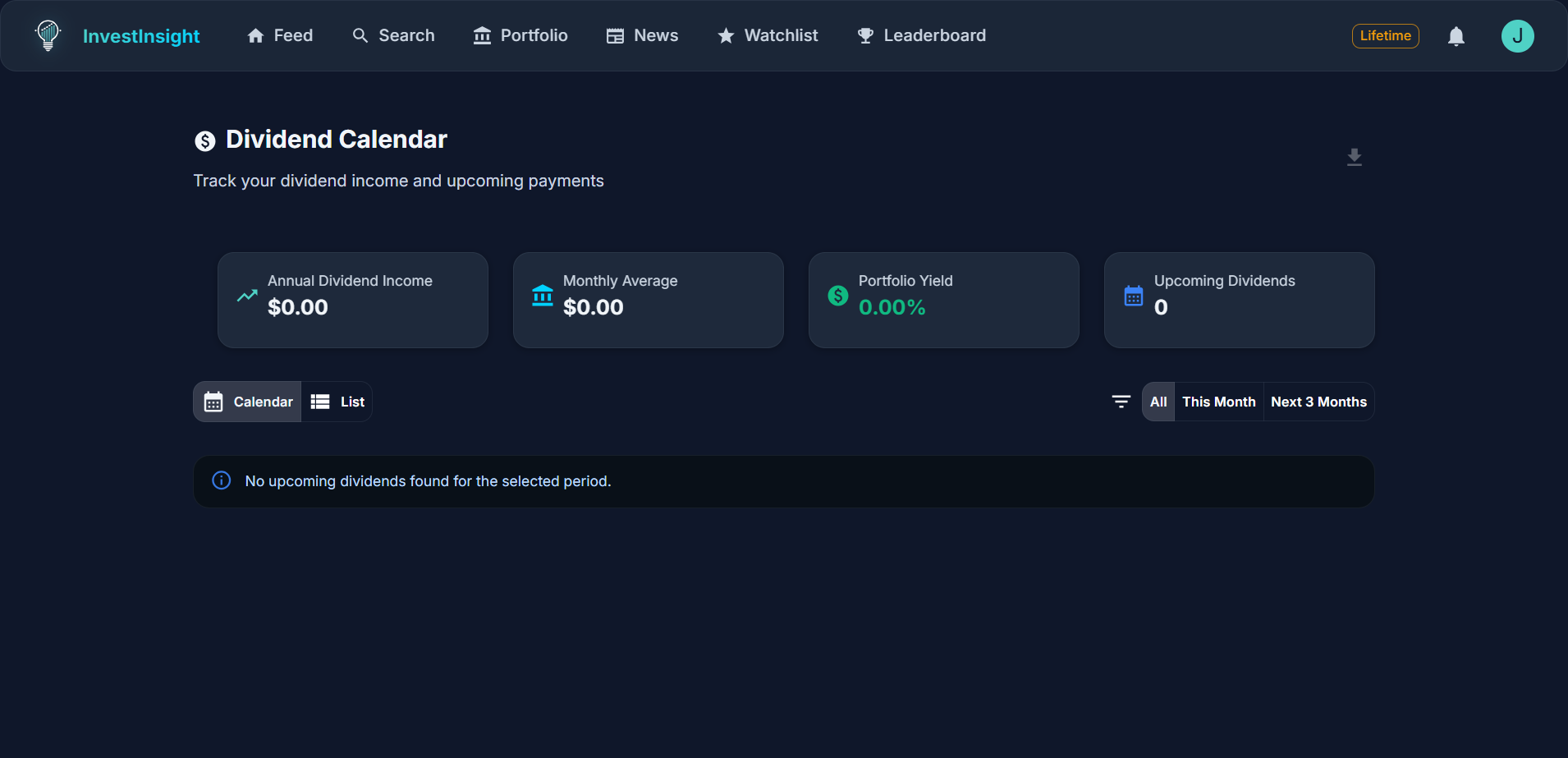
InvestInsight’s dividend tracker pulls your holdings together and shows upcoming payments alongside a projected annual income figure based on what you currently own. At a glance you can see roughly how much your portfolio is on track to pay you over the next twelve months – and how each new investment nudges that number up.
Because it sits inside the wider portfolio tracker, your dividends are shown in the context of your total returns, asset allocation and performance – so you never lose sight of the bigger picture while focusing on income. You can also follow other investors and see how experienced income investors structure their portfolios.
- See which holdings pay next, and when.
- Watch your forecast annual income update as you buy and sell.
- Track dividends across UK, US and other markets in one dashboard.
9. Common Beginner Mistakes to Avoid
Most dividend investing mistakes are avoidable once you know what to look for. Here are the ones that catch beginners most often.
- Chasing yield. The single biggest trap. A sky-high yield frequently reflects a falling share price and a dividend under threat, not a generous, healthy company.
- Ignoring dividend cover and cash flow. A dividend the company can’t afford is a dividend waiting to be cut.
- Over-concentration. Relying on one or two big payers – or a single sector – means one cut can slash your income. Diversify.
- Forgetting the ex-dividend date. Buying a share the day after it goes ex-dividend means waiting until the next cycle to get paid.
- Overlooking tax wrappers. Holding income-producing assets outside an ISA when you have unused allowance can mean paying avoidable tax.
- Judging on income alone. Always keep an eye on total return; a shrinking capital base can quietly erode the value of your income stream.
A simple mindset that helps
Treat every dividend as a claim on a real business. Ask whether that business is growing, whether it generates enough cash, and whether it can keep paying you for years – not just this quarter.
10. Putting It All Together: A Beginner’s Checklist
Ready to start? Here’s a practical order of operations for a new UK dividend investor:
- Open a tax-efficient account – a Stocks & Shares ISA is a sensible starting point for most beginners.
- Focus on quality first, yield second – look for companies with reasonable dividend cover, healthy cash flow and a solid payout history.
- Diversify across several companies and sectors to protect your income.
- Decide on reinvestment – reinvest for growth, or draw the cash if you need income now.
- Track everything – use a dividend calendar so payments and forecasts are always visible.
- Review periodically, not obsessively – check that your holdings’ dividends still look sustainable, and rebalance if one position grows too large.
Conclusion
Dividend investing rewards patience, diversification and a healthy scepticism of yields that look too good to be true. Get the fundamentals right – sustainable payers, sensible diversification, a tax-efficient wrapper and the discipline to reinvest – and you can build an income stream that compounds quietly in the background for years.
The easier that is to see and manage, the more likely you are to stick with it. If you’d like a clear view of your upcoming payments and a forecast of your projected annual income, try InvestInsight’s dividend tracker and watch your income picture come together in one place. Remember: this guide is education, not financial advice – always do your own research or speak to a qualified adviser before investing.