
How to Build a Dividend Portfolio for Monthly Income
Published: June 14, 2026
•Joseph Hughes
Building a dividend portfolio for monthly income is one of the most appealing goals for UK investors who want their savings to feel less like a spreadsheet and more like a regular pay cheque. The challenge is that most companies and funds pay dividends quarterly or twice a year, on their own schedules — so genuine month-in, month-out income takes a little planning. This guide walks through how to stagger pay dates, prioritise quality over headline yield, diversify sensibly, and use tools like a dividend calendar to visualise the cash flow you are actually building.
Key Takeaways
| Question | Short, Practical Answer |
|---|---|
| Can a single stock pay me monthly? | Rarely. Most UK and US shares pay quarterly or twice a year. You approximate monthly income by combining holdings with different pay months. |
| Should I chase the highest yield? | No. A very high yield often signals risk. Prioritise sustainability, dividend cover and growth over the headline number. |
| How many holdings do I need? | Enough to spread across pay months and sectors — often 15–30 positions, or fewer if you lean on income ETFs. |
| Reinvest or draw the income? | Reinvest while you are growing the pot; draw once you actually need the cash flow. Many investors do a blend. |
| What is the biggest mistake? | Yield traps and over-concentration — buying a high yield that gets cut, or leaning too hard on one sector or stock. |
| How do I see it all in one place? | Use a dividend calendar to map upcoming payments and projected annual income, then fill the gaps. |
1. Why “Monthly” Income Is Really a Scheduling Problem
The first thing to understand is that a dividend portfolio for monthly income is not usually built from monthly-paying investments. It is built from a mix of quarterly and semi-annual payers whose pay dates are deliberately spread across the calendar. When you line up holdings that pay in, say, January–April–July–October alongside others that pay February–May–August–November and a third group on March–June–September–December, the combined result lands something in your account almost every month.
Think of it as three overlapping quarterly rhythms. Individually each is lumpy; layered together they smooth out. That mental model — staggering pay months rather than hunting for a magical monthly stock — is the single most useful idea in this entire guide.
You are not trying to make each holding pay monthly. You are arranging the whole portfolio so that something pays every month.
2. Understand the Pay Schedules You Are Working With
Before you can stagger anything, you need to know how the things you own actually pay. UK and international dividend payers broadly fall into a few patterns:
- Quarterly payers — common among large US companies and many US-listed ETFs. Four payments a year make these the backbone of a staggered schedule.
- Semi-annual (twice-yearly) payers — the traditional pattern for many UK-listed companies, often an interim and a final dividend.
- Annual payers — less useful for smoothing income, though they can still contribute to the total.
- Monthly-paying funds — a smaller set of income-focused ETFs and investment trusts distribute monthly, which can simplify the job (more on that below).
Key dates to know
For any holding, three dates matter: the ex-dividend date (you must own the share before this to receive the payment), the record date, and the pay date (when the cash actually arrives). For scheduling income, the pay date is what you plot on your calendar — but the ex-dividend date is what determines whether you qualify. Always verify these on official company or fund sources, as they shift year to year.
3. Quality Over Yield: The Rule That Protects You
It is tempting to build a portfolio by sorting a screener from highest yield to lowest and buying from the top. This is how income investors get hurt. A very high yield is frequently the market pricing in a likely dividend cut — the share price has fallen for a reason, and the yield only looks generous because the denominator collapsed.
Instead, judge each candidate on the durability of the payout:
- Dividend cover — roughly how many times earnings (or free cash flow) exceed the dividend. Cover comfortably above 1× suggests the payout has breathing room; cover below 1× means the company is paying out more than it earns, which is rarely sustainable.
- Track record — a history of maintaining or growing the dividend through different conditions is reassuring, though never a guarantee.
- Dividend growth — a slightly lower yield that grows each year can beat a high static yield within a few years, and growth tends to signal a healthy underlying business.
- Balance sheet and payout ratio — heavy debt or a payout ratio near 100% leaves little margin if trading dips.
A sustainable 4% that grows will almost always serve you better than a fragile 9% that gets cut next year.
4. Diversify Across Sectors, Not Just Stocks
Spreading income across pay months solves timing. Spreading it across sectors solves risk. If your entire income relies on, for example, banks and oil majors, a downturn in either could hit several of your holdings at once — and dividend cuts in a sector often arrive together.
Aim to draw income from a range of areas — consumer staples, healthcare, utilities, financials, industrials, telecoms and so on — so that a shock to any one industry only dents a slice of your cash flow. Geographic diversification helps too: blending UK payers with international ones reduces reliance on a single economy or currency, though be aware that overseas dividends can carry withholding tax and currency effects worth understanding.
A quick concentration check
- No single holding should dominate your projected income — many investors cap any one position at a modest single-digit percentage of the total.
- No single sector should account for an outsized share of the whole.
- If one stock disappeared tomorrow, your monthly schedule should still hold together.
5. The Role of Income ETFs and Investment Trusts
You do not have to assemble every payment by hand. Income-focused ETFs and investment trusts can do a lot of the diversification and scheduling work for you:
- Instant diversification — a single income ETF may hold dozens or hundreds of dividend-paying companies, spreading sector and stock risk in one purchase.
- Predictable distributions — many pay quarterly, and some pay monthly, which makes filling calendar gaps far easier.
- Smoothing — certain investment trusts hold back reserves in good years to support the dividend in weaker ones, which can make income steadier than owning the underlying shares directly.
The trade-offs are worth noting: funds charge an ongoing fee, and a fund’s headline yield can include return of capital or fluctuate with markets. Check whether you are buying income (distributing) units, which pay cash out, versus accumulation units, which roll income back in automatically — only distributing units help build monthly cash flow. As always, read the fund documentation and verify the current distribution schedule.
6. Mixing Holdings to Approximate Monthly Income
Here is where the strategy comes together. Group your candidate holdings by the months in which they pay, then build a portfolio that covers all twelve months as evenly as your capital allows. In practice you are filling a grid: for each month, do you have at least one holding paying? Where are the gaps?
Common quarterly cycles cluster into three groups — often described as the January cycle, the February cycle and the March cycle (each repeating every three months). Holding representatives of all three, plus a couple of semi-annual UK payers and perhaps a monthly-paying fund, tends to produce a schedule with no empty months.
7. A Clearly-Illustrative Example Schedule
The table below is purely illustrative — it uses generic placeholders, not real companies, and no specific yields. Its only purpose is to show how staggering works. Do not treat it as a recommendation; your own schedule will depend on the holdings you research and verify.
| Month | Paying Holding(s) — illustrative only |
|---|---|
| January | US quarterly payer (Jan cycle) + monthly income ETF |
| February | US quarterly payer (Feb cycle) + monthly income ETF |
| March | US quarterly payer (Mar cycle) + UK final dividend + monthly income ETF |
| April | US quarterly payer (Jan cycle) + monthly income ETF |
| May | US quarterly payer (Feb cycle) + monthly income ETF |
| June | US quarterly payer (Mar cycle) + quarterly income ETF + monthly income ETF |
| July | US quarterly payer (Jan cycle) + monthly income ETF |
| August | US quarterly payer (Feb cycle) + UK interim dividend + monthly income ETF |
| September | US quarterly payer (Mar cycle) + quarterly income ETF + monthly income ETF |
| October | US quarterly payer (Jan cycle) + monthly income ETF |
| November | US quarterly payer (Feb cycle) + monthly income ETF |
| December | US quarterly payer (Mar cycle) + quarterly income ETF + monthly income ETF |
Notice how the three quarterly cycles, layered with a couple of semi-annual UK payers and a monthly ETF, leave no empty month. Notice too that the amounts would not be identical each month — smoothing pay dates is easier than smoothing pay amounts, which is where a cash buffer helps (see below).
8. Reinvest vs Draw: Two Modes for Two Life Stages
How you handle the income depends on where you are:
- Accumulation phase — if you do not yet need the cash, reinvesting dividends (manually or via a reinvestment option) compounds your position and accelerates growth. Each reinvested payment buys more shares, which pay more dividends, and so on.
- Drawdown phase — once you rely on the income, you switch to drawing it. This is when the monthly schedule really earns its keep, because a steady rhythm is far easier to budget around than three big lumps a year.
- A blend — many investors draw part of the income and reinvest the rest, keeping the portfolio growing while still enjoying some cash flow today.
Keep a cash buffer
Because monthly amounts vary, holding a small buffer of a few months’ income lets you pay yourself an even amount each month while the underlying payments fluctuate. It also cushions the shock if one holding trims its dividend.
9. Use InvestInsight to Visualise and Plan the Schedule
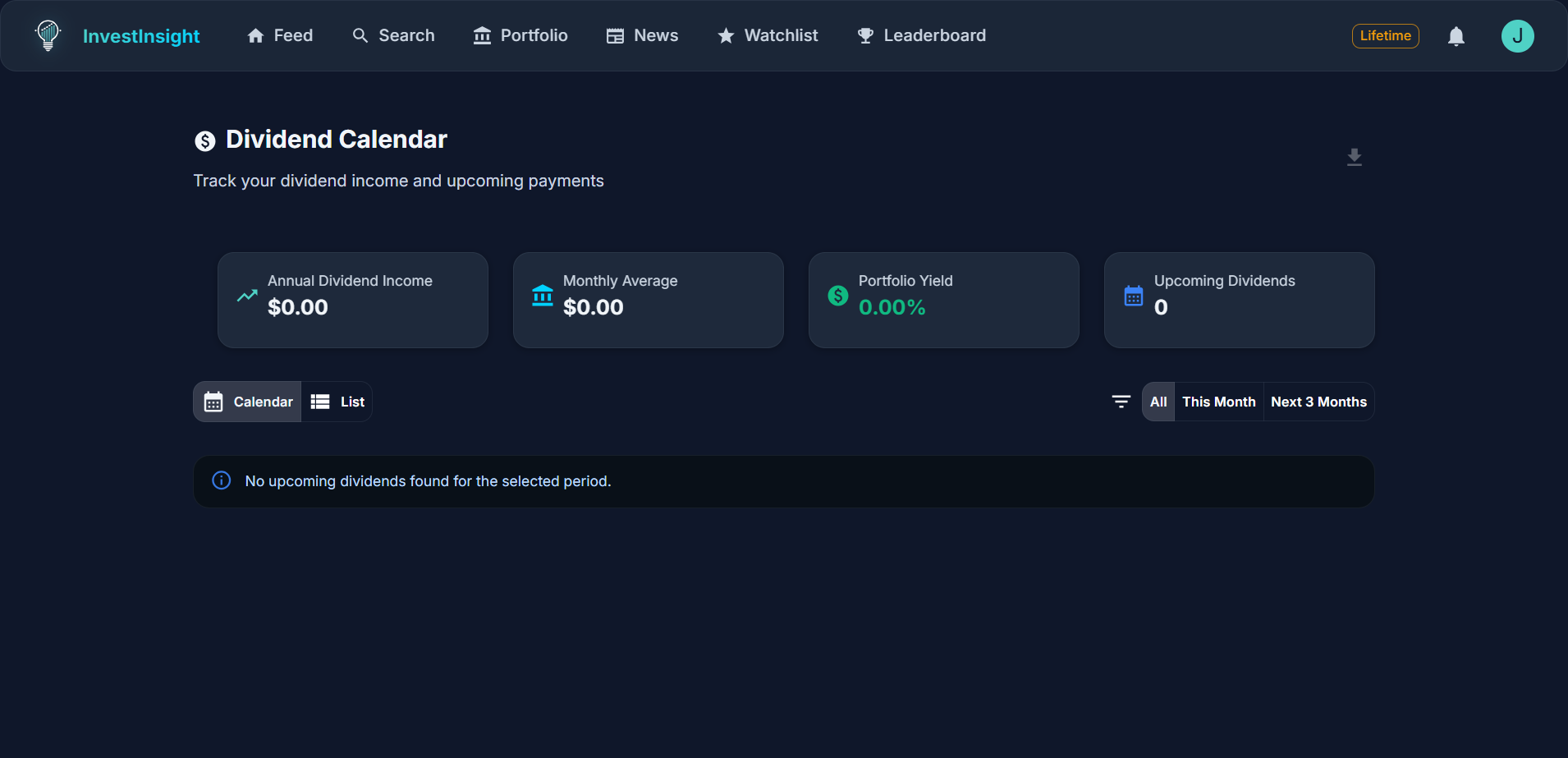
Mapping all of this in a spreadsheet is possible but painful — and it goes stale the moment a company changes its pay date. This is exactly what InvestInsight is built to handle. Our dividend tracker and dividend calendar let you:
- See upcoming payments laid out across the year, so the empty months in your schedule are obvious at a glance.
- View projected annual income based on your actual holdings, rather than guessing.
- Plan the schedule by spotting where you are over-concentrated in one month and where a new holding would fill a gap.
Combined with the broader portfolio tracker, you can watch the whole picture — total value, sector spread and income — in one place, and adjust as companies change their dividends. Seeing the calendar visually turns “I think I have a gap in July” into a concrete, fixable to-do.
10. Common Mistakes to Avoid
Even a well-planned income portfolio can be undermined by a few recurring errors:
- Yield traps — buying a stock purely because the yield is eye-catching, only for the dividend to be cut. Always check cover and the reason behind an unusually high yield.
- Over-concentration — leaning too heavily on one stock or sector so that a single cut wrecks your monthly plan.
- Ignoring total return — a stock that pays a steady dividend but steadily loses value is not really giving you income; it is returning your own capital. Watch the whole picture.
- Forgetting tax and wrappers — using an ISA or pension can shelter dividend income from tax. Holding income investments in a taxable account without considering the dividend allowance can cost you needlessly.
- Confusing accumulation and income units — accumulation funds reinvest automatically and pay you nothing to spend, which defeats the purpose if you want cash flow.
- Set-and-forget complacency — dividends are never guaranteed. Pay dates move, companies cut, and funds change policy. Review periodically.
Conclusion
A dividend portfolio for monthly income is less about finding exotic monthly-paying stocks and more about thoughtful scheduling: understand how your holdings pay, stagger those pay months so something lands every month, insist on sustainable quality over headline yield, and diversify across sectors and a few well-chosen income ETFs. Decide whether you are reinvesting or drawing, keep a small buffer to smooth the lumps, and revisit the plan as dividends inevitably change. None of this is financial advice, and every figure here is illustrative — always verify current yields, cover and pay dates from official sources before you invest.
The easiest way to make the schedule real is to see it. Track your dividends and map your upcoming payments and projected annual income with InvestInsight’s dividend calendar, then use the portfolio tracker to keep the whole plan on course — and start turning lumpy quarterly payouts into a smoother monthly rhythm.