
The Best Portfolio Trackers for UK Investors in 2026
Published: February 22, 2026
•Joseph Hughes
Finding the best portfolio tracker UK investors can genuinely rely on is harder than it should be. If you hold a few funds in an ISA, some individual shares in a general account, and a bit of crypto on the side, no single broker screen shows the whole picture — and most trackers are built US-first, treating sterling, LSE tickers and dividends as an afterthought. This guide walks through what actually matters and compares the leading options honestly, strengths and weaknesses included, so you can match a tool to how you really invest.
Key Takeaways
| Question | Short, Practical Answer |
|---|---|
| What’s the single most important feature? | Accurate consolidation across all your accounts, in GBP, with dividends and fees handled properly. |
| Do I need to pay for a good tracker? | No — several strong tools have free tiers. You typically pay for automation, unlimited holdings, and tax reporting. |
| What matters most for UK users specifically? | Native GBP handling, LSE coverage, dividend tracking, and ISA/GIA account separation. |
| Is a spreadsheet good enough? | For a small, simple portfolio, yes. It breaks down once you add currencies, dividends, and frequent trades. |
| Should I automate broker syncing? | It saves real time, but coverage varies by tool and broker. Check your specific broker is supported first. |
| What’s the fastest way to decide? | Shortlist two, import the same portfolio into both, and see which one you actually enjoy opening. |
How we compared: what to look for in the best portfolio tracker UK investors need
Every tool markets itself as the complete solution, so it helps to judge them against a fixed set of criteria rather than the marketing copy. Below is the framework we used — the same one we’d apply ourselves — covering the things that genuinely separate a good portfolio tracker from a frustrating one for UK investors.
- Multi-asset support. UK investors rarely stay in one lane. A serious tracker should hold stocks, ETFs, investment trusts, funds and crypto together, so you aren’t forced into a spreadsheet for whatever it doesn’t cover.
- Dividend and income handling. Income is central to a lot of UK strategies. A strong tracker should show upcoming dividends, historical payments and yield — not just capital value — and ideally let you plan income before it lands.
- Automatic sync. This is where tools diverge most. Options range from live broker sync, to CSV import, to manual entry. Automation is the difference between a tracker you keep using and one you quietly abandon — but only if it covers your broker.
- Cost. A free tier that quietly caps your holdings, or a steep annual plan for basic features, will cost you in frustration either way. Fair pricing and a usable free experience matter.
- GBP and UK focus. Many trackers are US-first and treat sterling as a conversion. You want a tool that reports your total in pounds, handles LSE tickers correctly (including pence-priced stocks), and understands ISAs and UK dividends.
- Analytics. Beyond the headline number, you want performance over time, allocation by asset class and geography, some read on risk and concentration, and — increasingly — AI-driven insight into your actual holdings.
- Social features. Being able to follow other investors and see how experienced people structure their portfolios is a real advantage if you learn by example, rather than sifting anonymous forum noise.
- Mobile. Whether a native app or a genuinely good responsive web app, you want something you can check on the go without fighting the interface.
No single tool tops every category, which is exactly why the “best” tracker is the one that fits your particular mix of assets, brokers and habits. With that framework in place, here’s how the main contenders stack up.
InvestInsight
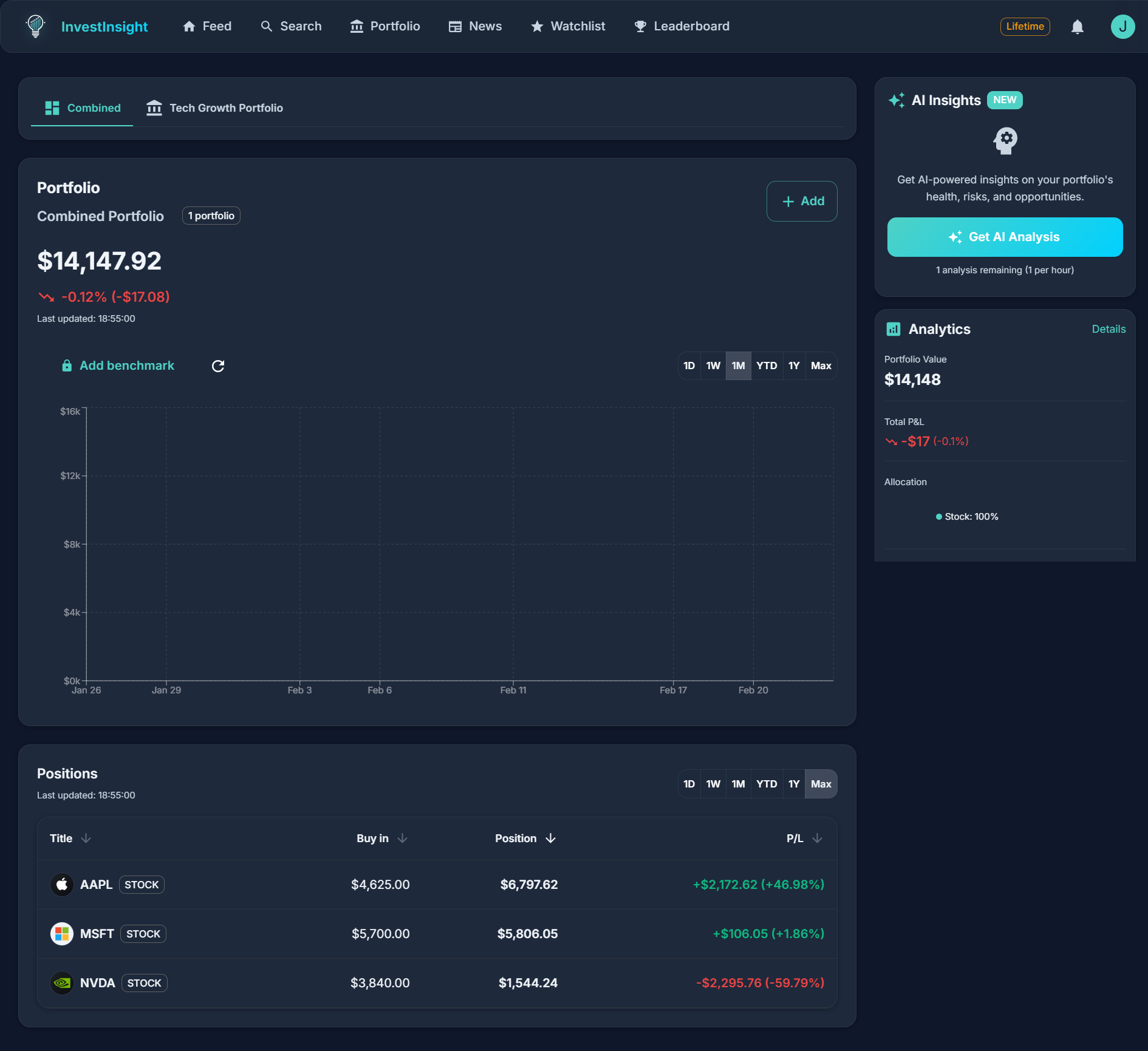
InvestInsight is a UK-focused, social-first tracker built around three ideas: consolidate everything in GBP, layer AI-driven analysis on top, and make investing a little more social. It brings stocks, ETFs, crypto and dividends into one sterling-native view, lets you follow other investors to see how they’re positioned, and adds a forward-looking dividend calendar that makes it a natural home for income-focused UK investors. It’s deliberately affordable, with a genuinely usable free experience.
Best for: UK investors who want a modern, community-driven tracker with AI insight and strong dividend tools, without paying premium prices.
- Pros:
- Genuine social investing — follow other investors and learn from real portfolios, not just charts.
- Built-in AI analysis that summarises your allocation, flags concentration, and answers plain-English questions about your holdings.
- A forward-looking dividend calendar, so you can see income coming rather than just what already landed.
- GBP-first reporting that handles LSE tickers and UK dividends correctly.
- Affordable pricing with a usable free tier.
- Cons:
- No native mobile app yet — it runs in the browser (which works well on a phone), with a dedicated app on the roadmap.
- Automatic broker sync currently covers Trading 212; other brokers are added by import or manual entry for now, with more live connections coming.
- As a newer platform, some niche analytics are still maturing.
If you’re weighing it against the incumbents, we’ve written straight, side-by-side comparisons: InvestInsight vs Getquin, InvestInsight vs Sharesight and InvestInsight vs Delta — so you can see where it leads and where it doesn’t.
Getquin
Getquin is a well-established European tracker with a strong community angle and a polished mobile experience. It handles a broad range of assets, offers solid analytics, and has built an active base of users who share portfolios and discuss holdings. For many investors it feels mature and complete, and its breadth of broker connections is a real advantage if you hold accounts across several platforms.
Best for: Investors who want a mature, feature-rich all-in-one tracker with an established community and a strong mobile-first experience.
- Pros:
- Slick, well-designed apps and a lively, genuinely active social feed.
- Broad multi-asset coverage and a well-developed analytics suite.
- Wide range of broker and account connections.
- Available on mobile as well as the web.
- Cons:
- As a pan-European product, some UK-specific niceties (sterling as the unambiguous default, deep LSE and dividend nuance) can feel secondary.
- Certain analytics and connections sit behind a paid tier.
- The breadth of features can feel like a lot to navigate at first.
Sharesight
Sharesight is the long-standing specialist for performance and tax reporting, and it’s especially popular with dividend and long-term investors. Its dividend history, corporate-action handling and tax-oriented reports are genuinely best-in-class, and it supports a large number of global exchanges including the LSE. If your priority is meticulous record-keeping and clean figures at self-assessment time, it’s hard to beat.
Best for: Dividend and buy-and-hold investors who care most about accurate performance history and tax reporting.
- Pros:
- Best-in-class tax and dividend reporting, with reinvestment, corporate actions and currency effects handled meticulously.
- Excellent long-term performance history, useful at year-end or for an accountant.
- Wide exchange coverage, including UK-listed securities.
- Reliable import options from many brokers.
- Cons:
- Reporting-led rather than social or AI-driven, and the interface prioritises depth over friendliness.
- Limited crypto support compared with multi-asset rivals.
- The free tier is restrictive on holdings, so most serious users end up on a paid plan.
Delta
Delta earned its reputation as a crypto tracker and remains one of the cleanest ways to follow coins, tokens and exchange balances. It has since broadened into stocks and other assets, and its mobile-first design is genuinely slick and fast. For an investor whose portfolio leans heavily toward digital assets, Delta’s depth in that area is a real draw.
Best for: Crypto-heavy investors who want a polished, mobile-first tracker with strong digital-asset coverage.
- Pros:
- Genuinely excellent for crypto, with wide exchange and wallet coverage.
- Clean, fast, mobile-first interface.
- Now supports stocks and other assets alongside crypto.
- A strong experience if your portfolio is digital-asset dominant.
- Cons:
- Traditional-equity and dividend features are less developed than tools built for stocks first.
- Not tailored to UK tax, LSE specifics or GBP-first reporting.
- Community and social elements are limited — it’s a crypto tracker that also does shares, rather than the reverse.
Your broker’s built-in tracker (Trading 212 or Freetrade)
Many UK investors start — and stay — with the tracker built into their broker. Platforms like Trading 212 and Freetrade show your holdings, returns and, in some cases, dividends without any extra setup. The data is always live and accurate because it comes straight from the source, which is a real strength. The limitation is scope: a broker can only ever show you what’s held with that broker.
Best for: Investors who keep everything with a single broker and want a zero-effort, always-accurate view.
- Pros:
- Zero setup — it’s already there, with no syncing to break and no manual entry.
- Perfectly accurate data and performance figures that match your statements exactly.
- Usually free and integrated into the broker’s own app.
- UK brokers report in GBP and handle ISAs natively.
- Cons:
- Only shows assets held with that one broker — you lose the consolidated view the moment you invest in more than one place.
- Crypto and outside holdings usually aren’t included.
- Analytics, dividend forecasting and social features are typically basic or absent.
A DIY spreadsheet
The humble spreadsheet remains a legitimate tool, and plenty of thoughtful investors never move off one. For a small, stable portfolio it can be perfectly adequate: you control every column, every formula and every assumption, and it costs nothing. The trade-off is time and reliability, because prices, dividends and currency conversions all have to be maintained by hand.
Best for: Hands-on investors with a small, simple portfolio who value total control and don’t mind the upkeep.
- Pros:
- Completely free and infinitely customisable.
- Full control over calculations and layout — you can model anything.
- No third party ever sees your holdings.
- Great for learning exactly how your returns are built up.
- Cons:
- Prices don’t update on their own without fiddly formulas.
- No automatic dividend tracking, currency handling or broker sync unless you build it yourself.
- It becomes a maintenance chore — and increasingly error-prone — as your portfolio grows.
The best portfolio tracker isn’t the one with the longest feature list — it’s the one you’ll still be opening in six months. Fit for your actual brokers, holdings and habits beats a spec sheet every time.
Which should you choose?
The right pick depends far more on your style of investing than on any headline ranking. Here’s how the options map to common investor types.
- The dividend investor. If income is your focus, you want accurate dividend history and, ideally, a view of what’s coming. Sharesight excels at the historical and tax side, while InvestInsight’s forward-looking dividend calendar helps you plan income before it lands — a strong combination if you want both record-keeping and foresight.
- The passive index investor. If you hold a handful of global ETFs and mostly want a clean, honest picture of allocation and long-term performance, almost any dedicated tracker will do. A broker’s built-in view may even be enough if everything sits in one account; step up to InvestInsight or Sharesight once you spread across platforms.
- The crypto-heavy investor. If digital assets dominate your portfolio, Delta’s depth in coins, tokens and exchange balances is hard to match. If you want crypto tracked alongside stocks and ETFs in a single GBP view, InvestInsight or Getquin will serve you better as an all-in-one.
- The investor who wants community. If you learn best by seeing how others invest, the social layer matters. InvestInsight is built around following real investors and sharing insight, with Getquin also offering an established community. A spreadsheet or broker app, by contrast, is a solitary experience.
If you can’t place yourself neatly in one bucket — a dividend investor who also dabbles in crypto and likes learning from others, say — that’s exactly the overlap a multi-asset, social, GBP-first tracker is designed to cover. And whichever way you lean, the honest test is the same: import the same portfolio into your top two choices and live with them for a week. The one you find yourself opening without prompting is your answer.
Conclusion
There isn’t a single “best” tracker for every UK investor — there’s the best one for your brokers, holdings and habits, and any honest comparison has to admit that. Sharesight wins on tax and dividend reporting, Delta on crypto, Getquin on mature mobile-social, and your broker’s own view on zero-effort accuracy for a single account. Where InvestInsight stands out is in bringing the whole picture together in GBP, adding a genuine dividend calendar and AI analysis, and making the experience a little more social — at a price that doesn’t sting, with the honest caveats that our native mobile app is still on the way and automatic sync currently covers Trading 212, with more brokers coming.
If that combination sounds like the way you invest, the simplest next step is to try it with your own numbers. Import a portfolio, open the portfolio tracker, and see whether one consolidated GBP view changes how clearly you understand where you stand. No pressure and no hype — just your holdings, finally in one place.